Bamboo Cutlery and PPWR: Is It a Future-Proof Choice for EU Buyers?
- Share
- Issue Time
- Sep 10,2026
Summary
Is bamboo cutlery a future-proof sourcing choice under the EU's PPWR? A procurement-focused look at what future-proof actually requires, where bamboo fits, and what to verify before choosing a supplier.

Bamboo Cutlery and PPWR: Is It a Future-Proof Choice for EU Buyers?
If you're responsible for sourcing disposable tableware for a restaurant group, catering company, or food delivery brand in Europe, PPWR raises a practical question: will the materials you're buying today still make sense as EU packaging requirements keep evolving?
Bamboo cutlery is one option increasingly discussed as an alternative to plastic. But being renewable doesn't automatically make a product PPWR-compliant, and it doesn't automatically make it future-proof either. Those are two different questions, and conflating them is where a lot of sourcing decisions run into trouble later.
This article won't tell you bamboo cutlery is a blanket solution, because no single material is. What it will do is walk through what PPWR actually asks of buyers, what "future-proof" means in practical terms, where bamboo genuinely fits, and — just as importantly — what to verify before choosing a supplier.
Key takeaways for EU buyers
- PPWR does not ban bamboo cutlery. Regulation (EU) 2025/40 governs packaging and packaging waste, not every food-contact product. Scope depends on how a product is packaged and placed on the market.
- Renewable is not the same as compliant. They are two separate questions, and treating them as one is where sourcing decisions run into trouble later.
- Five criteria define future-proof. Regulatory alignment, material transparency, supply stability, product quality, and your own buyer requirements.
- The supplier matters more than the material. Traceability, documentation and food-contact compliance are properties of the supplier, not of bamboo.
- Verify before you commit: raw material origin, manufacturer versus trader, certifications on request, QC process, and demonstrated capacity.

What Is PPWR and Why Does It Matter to Food Service Buyers?
PPWR — formally Regulation (EU) 2025/40 — is the EU's updated framework for packaging and packaging waste. It entered into force in February 2025 and began applying across member states from August 2026, replacing the older Packaging Directive with rules that apply directly and uniformly in every EU country rather than being interpreted differently market by market.
It's worth being precise about scope here, because it's easy to overstate. PPWR's core subject is packaging and packaging waste — not every food-contact product automatically falls under it simply because it touches food. PPWR does not regulate bamboo cutlery simply because it is a food-contact item. Whether a particular product falls within the regulation depends on how it is marketed, supplied, and used within the EU packaging system — for example, whether it's sold as standalone tableware, bundled as part of a packaging set, or supplied in bulk to a food service operator.
The regulation text is published on EUR-Lex, and the European Commission maintains a packaging and packaging waste portal that tracks the secondary legislation still being finalised. Buyers tracking compliance should monitor that page rather than working to a single cut-off date.
The question most buyers should be asking
That distinction matters for buyers because it means the right question usually isn't "is this product PPWR-compliant?" It's closer to "does this sourcing decision hold up under the direction PPWR and the broader EU packaging framework are pushing the market — toward recyclability, reduced reliance on virgin fossil-based materials, and clearer supply chain documentation?"
What Does "Future-Proof" Really Mean for Bamboo Cutlery Sourcing?
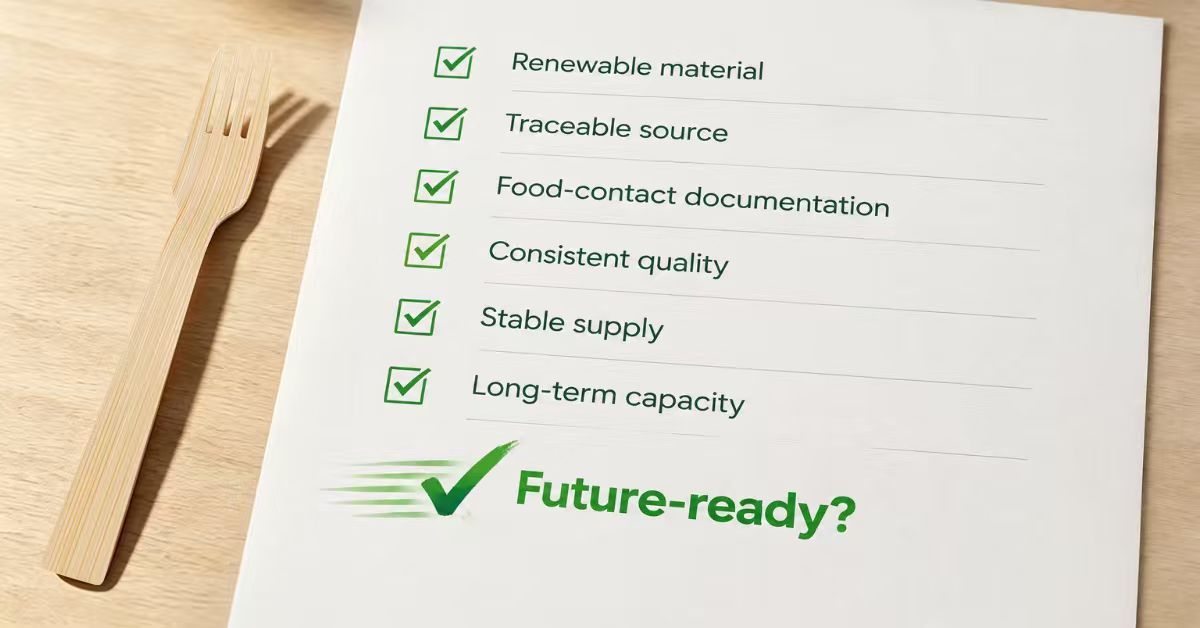
Before comparing materials, it helps to define "future-proof" as something closer to an evaluation model than a marketing term. A useful way to break it down is five criteria a buyer can actually check a product and supplier against:
Regulatory alignment
PPWR is being implemented in phases through 2040, and some provisions are still being finalized through secondary legislation. A future-proof choice isn't necessarily one that satisfies every current requirement — it's one whose underlying material and supply model is unlikely to be caught off guard by the next round of rules.
Material transparency
Buyers are being asked, more often and more formally, where their materials come from. A product backed by clear information about raw material origin and processing is easier to defend in an audit than one where the paper trail stops at a trading company.
Supply stability
Regulatory alignment on paper doesn't help if a supplier can't actually deliver. Consistent raw material access, production capacity, and lead times matter as much as the material itself, particularly for buyers locking in annual contracts.
Product quality
Consistency, food-contact safety, and structural reliability need to hold across every batch, not just the sample that was approved during onboarding.
Buyer requirements
Ultimately, "future-proof" isn't a fixed standard — it depends on what a given buyer's own customers, contracts, and sustainability commitments require.
The rest of this article works through bamboo cutlery against these five criteria, rather than treating "renewable" as a stand-in for all of them.
Why Is Bamboo Cutlery Being Considered as an Alternative to Plastic?
Bamboo's relatively fast growth cycle — many species can be harvested on a multi-year rotation without replanting — makes it an attractive renewable feedstock compared to slower-growing hardwoods or petroleum-based plastics. But for a buyer, the more relevant question isn't how fast bamboo grows. It's whether that renewable resource translates into a stable, traceable supply at commercial scale, which is a question about the supplier, not the plant.
Bamboo cutlery also has a natural look and feel that fits the branding many food service businesses are building around sustainability, without requiring dyes or synthetic coatings to communicate that positioning. And it isn't a niche or unproven product — it already shows up across restaurants, delivery and takeaway packaging, coffee shops, and catered events, which means most buyers evaluating it are deciding whether to formalize a sourcing relationship, not testing something new to the market.
How Does Bamboo Cutlery Fit Into the Broader PPWR Landscape?
Bamboo can fit into some of the broader sustainability objectives influencing European packaging decisions, but material choice alone does not determine PPWR compliance — that depends on packaging design, documentation, and how a specific product is placed on the market.
With that caveat in place, a few directional trends are worth understanding:
- Non-plastic alternatives are being evaluated side by side. As European businesses review their use of single-use plastics and alternative materials, bamboo cutlery is one option worth evaluating alongside other non-plastic alternatives like FSC-certified wood — not because it carries a compliance label, but because it removes fossil-based material from the mix entirely.
- Documentation and traceability expectations are rising. PPWR increases the documentation and traceability expectations placed on packaging and food-contact materials generally. Suppliers who can clearly show where their raw material comes from and how it's processed are better positioned to support buyers through that shift than suppliers who can't.
- Buyer-side ESG targets stand on their own. Beyond the regulation itself, many food service brands have their own sustainability targets and ESG reporting commitments that bamboo cutlery can support directly, independent of whether a specific PPWR clause applies to a given product.
What Should Buyers Watch Out for When Sourcing Bamboo Cutlery?
Most content on bamboo cutlery stops at the upside. A genuinely useful sourcing decision has to account for the harder questions too — the ones that tend to surface later in an audit or supplier review, not before.
- Certifications. There is no single certification that automatically makes bamboo cutlery compliant with every EU requirement. Depending on the market and buyer requirements, suppliers may need to provide food-contact test reports, FSC documentation where applicable, and factory audit records — and vague or unverifiable claims are worth treating with caution.
- Traceability. "Bamboo" as a raw material can come from a wide range of sources and processing methods, and traceability varies enormously between suppliers. It's reasonable to ask exactly where the raw bamboo is grown, harvested, and processed, and to expect a specific answer rather than a general one.
- Product quality. Bamboo is a natural material, so quality control matters more than it might for uniform plastic products. Dimensional consistency, splinter-free edges, and adequate strength for the intended use are worth verifying with samples before committing to volume.
- Supply capacity. Can the supplier reliably meet demand during peak seasons, and does their raw material supply depend on open-market purchasing or something closer to direct sourcing? That question is worth its own section below.
How to Evaluate a Bamboo Cutlery Supplier for Long-Term Supply
This is where sourcing decisions tend to get tested in practice, and it's worth breaking down into specifics rather than general principles.
Raw material source
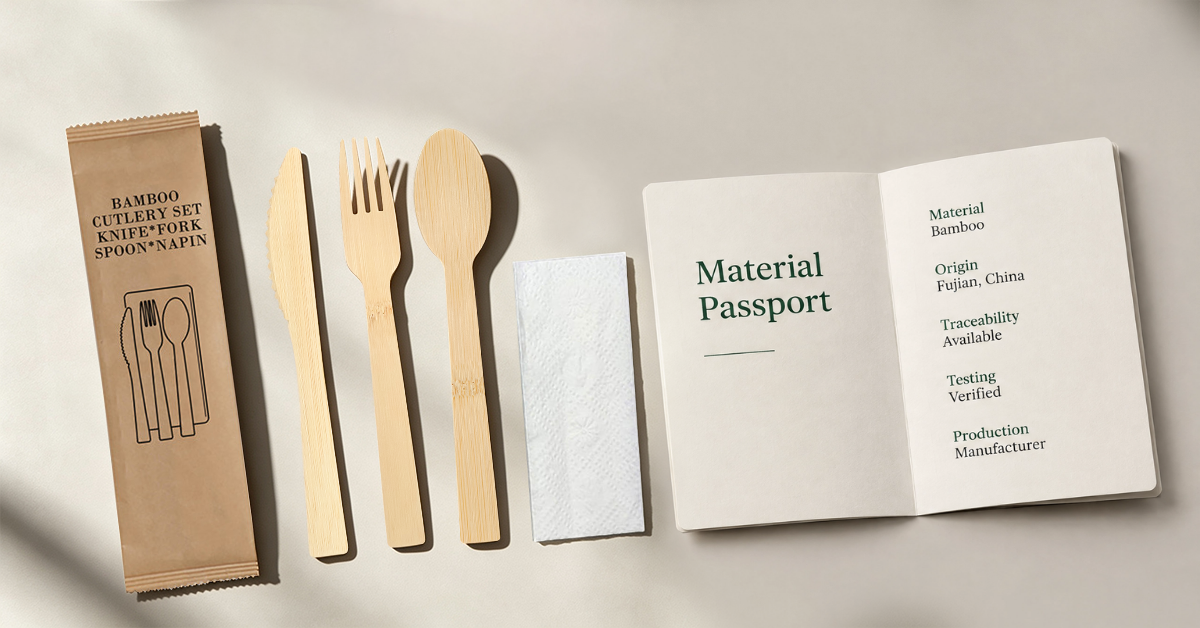
It's fair to ask a supplier to name the growing region and describe how the bamboo is harvested and matured, not just confirm that it's "sustainably sourced." QL Bamboo, for example, manages its own 666-hectare bamboo forest in Nanping, Fujian — a region known for producing dense, high-quality moso bamboo — and sources only bamboo matured over five years, which affects both strength and defect rates in the finished product.
Manufacturer vs. trader
There's a meaningful difference between a company that processes bamboo from raw material through to finished cutlery, and one that sources finished products from various third-party factories. The former usually offers more consistency and more direct answers about origin and process — QL, for instance, runs its own processing chain from harvested bamboo through to packaged product, rather than reselling stock sourced from other manufacturers.
Production capacity
For buyers planning volume growth, it's worth confirming a supplier's actual manufacturing footprint and monthly output rather than taking capacity claims at face value.
Quality control
Ask what inspection happens before shipment — manual checks, automated sorting, or both — and whether the supplier can share defect-rate data rather than just assurances.
Warehousing and export experience
Dedicated warehouse capacity that can buffer seasonal demand spikes, along with a track record of exporting to your region specifically, both reduce the risk of the lead-time surprises that tend to derail contracts.
None of this means every buyer needs a supplier with exactly this profile — smaller programs may reasonably prioritize flexibility or price over scale. But knowing which of these factors matter for your own volume and timeline makes supplier comparisons far more concrete than comparing marketing pages. You can review the wider bamboo tableware range to see how these factors map to actual product specifications.
Bamboo Cutlery vs. Wooden and Plastic Alternatives
| Consideration | Bamboo Cutlery | Wooden Cutlery | Plastic Cutlery |
|---|---|---|---|
| Raw material | Bamboo | Wood | Petroleum-based polymers |
| Renewable feedstock | Yes* | Yes* | No |
| Natural appearance | Yes | Yes | Usually no |
| Supplier traceability | Depends on supplier | Depends on supplier | Depends on supplier |
| Food-contact requirements | Must be verified | Must be verified | Must be verified |
| End-of-life considerations | Depends on local waste system | Depends on local waste system | Depends on material and local system |
*Renewability does not by itself determine regulatory compliance or end-of-life treatment.
The rows that read "depends on supplier" or "must be verified" across all three materials are the actual point of this table. Renewability and appearance are largely fixed properties of the material — they don't change much between one bamboo supplier and another. Traceability, documentation, and consistent food-contact compliance are not properties of the material at all; they're properties of the specific supplier and how they run their business. That's why supplier evaluation ends up mattering as much as material selection, if not more.
Is Bamboo Cutlery a Future-Proof Choice?
There isn't a clean yes-or-no answer, and any source that gives you one is oversimplifying. While every sourcing decision depends on market requirements, supplier capabilities, and evolving regulations, bamboo cutlery is a reasonable option for food service businesses looking for renewable materials, clearer supply chain documentation, and alignment with broader sustainability strategies.
Measured against the five criteria above, bamboo as a material scores well on regulatory direction and buyer/consumer expectations. Whether it scores well on transparency, supply stability, and quality depends entirely on the supplier — which is exactly why those factors deserve more scrutiny in the sourcing process than the material category itself.
If you're currently reviewing your cutlery sourcing against PPWR and your own sustainability commitments, the most useful next step is usually a direct conversation with a supplier who's willing to answer the harder questions above — not just the easy ones.
Bamboo Cutlery and PPWR: Frequently Asked Questions
Does PPWR ban plastic cutlery?
PPWR doesn't issue a single blanket ban on all plastic cutlery, but it does push the packaging and food-contact market toward reduced plastic use, recyclability, and reduced reliance on fossil-based materials, with specific restrictions and targets phasing in over time. Buyers relying on single-use plastic cutlery should expect increasing pressure — regulatory and commercial — to shift toward alternatives.
Is bamboo cutlery affected by PPWR?
Not automatically, and not simply because it's a food-contact product. Whether a specific bamboo cutlery item falls within PPWR's scope depends on how it's marketed, packaged, and supplied within the EU market. What buyers can expect regardless is growing pressure — from regulation and from their own customers — toward traceable, well-documented sourcing.
What certifications should buyers look for when sourcing bamboo cutlery?
There is no single certification that automatically makes bamboo cutlery compliant with every EU requirement. Depending on the market and the buyer's own requirements, suppliers may need to provide food-contact test reports, FSC documentation where applicable, factory audit reports, and other supporting records — and buyers should expect a supplier to produce these on request, not just reference them. Where compostability is claimed on packaging, buyers should also expect evidence against the harmonised standard.
Is bamboo cutlery suitable for restaurant chains?
Yes, with the right supplier. Restaurant chains typically need consistent quality across large volumes and dependable supply during peak periods, both of which are achievable with an established manufacturer that controls its own raw material and production — but this is worth confirming directly with a given supplier rather than assuming it applies across the category.
How can buyers evaluate bamboo cutlery suppliers?
Focus on raw material traceability, whether the company is a manufacturer or a trader, certification status, quality control processes, and demonstrated production and warehousing capacity — the areas covered above. A supplier willing to discuss all of these in specific terms, rather than steering the conversation back to price, is usually the more reliable long-term partner. For the ordering, documentation and quality-control questions EU buyers raise most often, see our bamboo tableware buying FAQ.
- Regulation (EU) 2025/40 on packaging and packaging waste — EUR-Lex, official journal text
- Packaging and packaging waste — European Commission
- FSC certification — Forest Stewardship Council