How Bamboo Skewers Are Made
- Share
- publisher
- Eternity
- Issue Time
- Mar 20,2026
Summary
See how quality skewers are made. Learn our Moso bamboo sourcing and 14-step process for splinter-free, safe BBQ tools.

Ever picked up a bamboo skewer and wondered how it's made?It looks simple—just a thin stick of bamboo, right?Actually, there are 14 precise steps between raw bamboo and the smooth skewer in your hand. Skip even one step, and you get rough, weak, or inconsistent products.Today, we're taking you inside our factory to show you exactly how quality bamboo skewers are made—and why the process matters.
Why Manufacturing Process = Quality
Here's what most buyers don't realize:
Two factories can use the same bamboo but produce completely different quality.The difference? The process.
Skip proper drying → skewers warp and mold
Rush the polishing → rough, splintery surface
No sorting → mixed quality in every bag
Wrong sharpening → tips break when you use them
At QL, every step is designed for one thing: consistent, premium quality.Let's walk through our process.
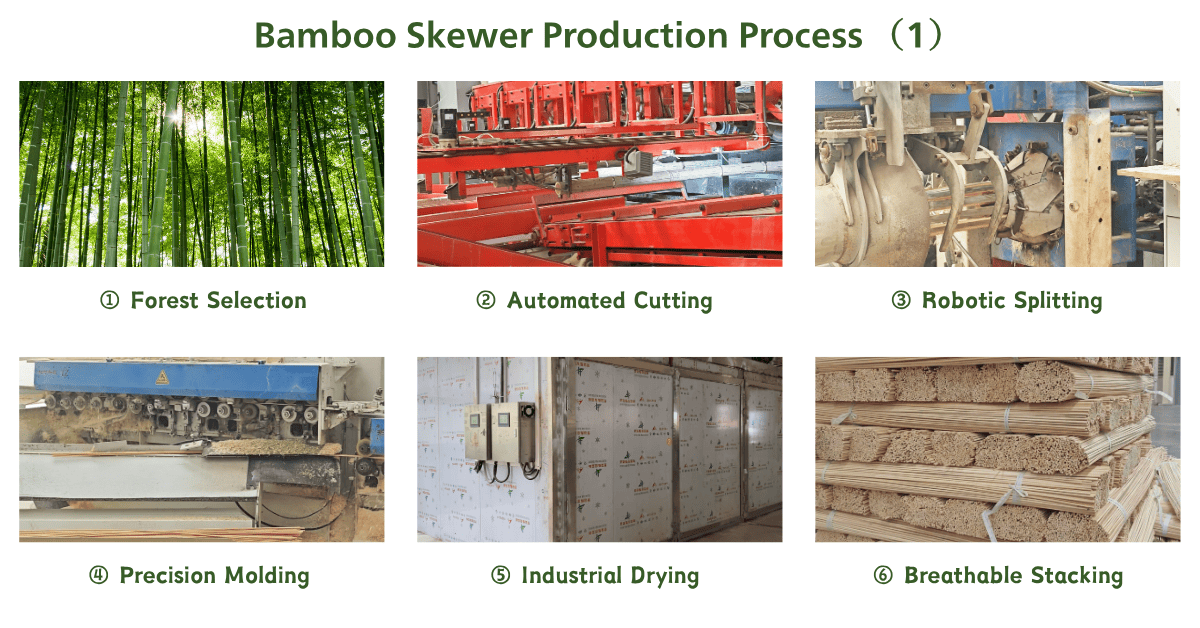
Step 1-2: Premium Bamboo Selection + Automated Cutting
What we do:
We select only 4+ year mature Moso bamboo from our 666-hectare Fujian forest. Then automated machines cut it to preset lengths.Why maturity matters:
1-3 years old → too soft, breaks easily
4-5 years old → dense fibers, maximum strength
6+ years old → too hard, difficult to process
Why automation matters:
Manual cutting = inconsistent lengths (some 28cm, some 32cm)Automated cutting = every piece exactly the same
Result: Premium raw material, standardized from the start.
Step 3-4: Robotic Splitting + Precision Molding
What happens:
Robotic arms feed bamboo segments into multi-blade machines. Digital settings split them into equal-sized slats. Then high-speed tools shape them into round strips of exact diameters:2.5mm → toothpicks
3mm → small skewers
4mm → standard BBQ skewers
5mm+ → heavy-duty skewers
Why precision matters:
Imagine threading meat onto a skewer that varies from 3mm to 5mm. Frustrating, right?Our machines ensure every millimeter is consistent.Result: Perfectly uniform bamboo strips.
Step 5-6: Industrial Drying + Resting (The Critical Steps)
What we do:
Strips are dried in industrial ovens with carefully controlled time and temperature. Final moisture content: ≤12%.Then they're cross-stacked (not piled flat) and rest for 24-48 hours.Why 12% moisture is the magic number:
Too wet (>15%) → warps, mold, short shelf life
Just right (10-12%) → stable, strong, long-lasting
Too dry (<8%) → brittle, cracks easily
Why the "resting" step matters:
Like letting bread dough rest, bamboo needs time to equalize moisture and release internal stress. Skip this, and skewers can warp later—even after packaging.Result: Stable bamboo that won't warp or mold.
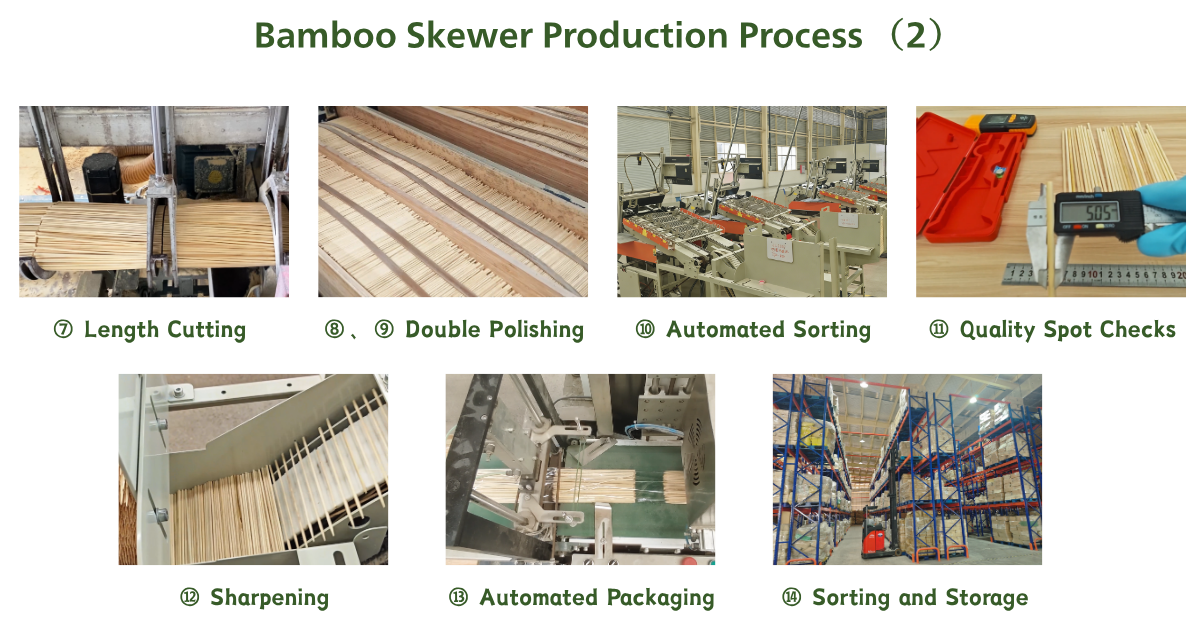
Step 7-9: Cutting + Double Polishing
Custom length cutting:
We cut to exact order requirements: 15cm, 20cm, 25cm, 30cm, or custom lengths.Then comes the quality secret: double polishing.
First polish (10 minutes): Dry grinding removes surface roughness and bamboo fibers.
Second polish (adjustable time): Food-grade polishing powder creates that silky-smooth finish.
Why double-polishing matters:
Most cheap suppliers skip the second polish to save time. We don't.The quality test:
Run your finger along our skewer:Smooth (no rough spots)
Consistent texture throughout
Zero splinters
Result: Premium-smooth surface.
Step 10-11: Automated Sorting + Human QC
Infrared sorting:
Every single skewer is scanned for:Color consistency、Surface quality、Straightness、Diameter uniformity
The machine sees defects invisible to human eyes. Premium pieces → finished goods. Substandard → rejected.
Then human spot-checks:
Our QC teams manually verify:Length accuracy (±0.5mm tolerance)、Diameter consistency、Moisture level (≤12%)
Sample rate:2-5% of every batch (industry standard is only 0.5-1%).
Result: Double-verified quality—machines + humans.
Step 12: Precision Sharpening (For Pointed Skewers)
What happens:
Automated machines sharpen tips to exact specifications.What makes a good tip:
Sharp enough to pierce food easily
Smooth (no splinters)
Consistent angle on every skewer
Why automation beats hand-sharpening:
Hand-sharpening = inconsistent tips (some too sharp and break, some too dull)Machine sharpening = uniform tips every time
Result: Perfect tips for easy threading.
Step 13-14: Automated Packaging + Final Storage
Packaging:
Skewers are auto-counted, film-wrapped, and sealed. Every package is weighed to verify count. If weight is off, it's flagged for recount.Then sorted by:Product type (length, diameter)、Order ID、Destination
Warehouse storage: Climate-controlled to prevent moisture absorption. Organized for fast, accurate shipping.
Result: Precise counts, fast fulfillment, ready to ship.
Compare: Premium vs. Cheap Skewers
| Feature | Cheap Skewer | QL Skewer |
| Raw material | Mixed age, random source | 4+ year Fujian bamboo |
| Surface | Rough, visible fibers | Silky smooth (double polish) |
| Strength | Breaks easily | Tough, flexible |
Consistency | Mixed sizes in one bag | Uniform throughout |
Moisture | Often too wet (warps) | Controlled ≤12% |
Tips | Uneven, splintery | Smooth, uniform angle |
Quality check | Minimal | 100% machine + spot checks |
Why Our Process = Your Peace of Mind
Starting right: → Premium bamboo from our own 666-hectare forest (not random suppliers)
Automation: → Consistent sizing, no human error
Controlled drying: → Perfect moisture = no warping or mold
Double polishing: → Smooth, splinter-free (most skip this step)
100% sorting: → Automated inspection of every single skewer
Multiple certifications: → FSC, FDA, LFGB verified
Ready to experience QL quality?
Contact us for:
Free sample skewers
Custom specifications
Bulk pricing
Technical consultation
Questions about our process? We're here to help. Because transparency builds trust. And trust builds partnerships.