How to Check Bamboo Skewer Straightness and Surface Quality Before Bulk Ordering
How to Check Bamboo Skewer Straightness and Surface Quality Before Bulk Ordering
Share
publisher
QL Bamboo
Issue Time
Oct 16,2026
Summary
A step-by-step inspection guide for wholesale buyers: how to check bamboo skewer straightness against a flat reference surface, inspect surface splinters and cracks, judge tip condition and dimensions, and write the acceptance criteria into the order.
Bamboo skewer quality inspection should cover straightness, surface finish, tip condition and dimensional consistency. Buyers can screen samples on a flat reference surface, inspect for splinters and cracks under suitable lighting, and measure key dimensions against the agreed specification. For bulk orders, inspection results should be recorded and judged using a defined sampling plan and written acceptance criteria.
Bends, splinters, cracks and rough tips make food harder to load and cartons look inconsistent, and a few good samples cannot show how a whole batch will behave. This guide shows how to check each point, how to record it, and how to write the criteria into your order.
Short answer
How do you inspect bamboo skewer quality? Inspect bamboo skewers in four steps: check straightness against a flat reference surface or an agreed fixture, inspect the surface for splinters, cracks, rough patches and stains, examine the tip and the key dimensions, then record every result against the approved sample and the agreed acceptance criteria. A skewer passes only when it meets the written specification both sides agreed, not when it merely looks good.
Wholesale buyers who inspect against written criteria catch the expensive problems early. Skipping that step usually shows up later as:
Visible bends and twist that a carton-by-carton check would have flagged
Splinters, burrs and rough patches that snag food and packaging
Cracks, split ends and blunt or off-centre tips
Stains, discoloration or suspected mould found after arrival
Tip, length and diameter drifting from batch to batch
Disputes with the supplier because no acceptance criteria were written down
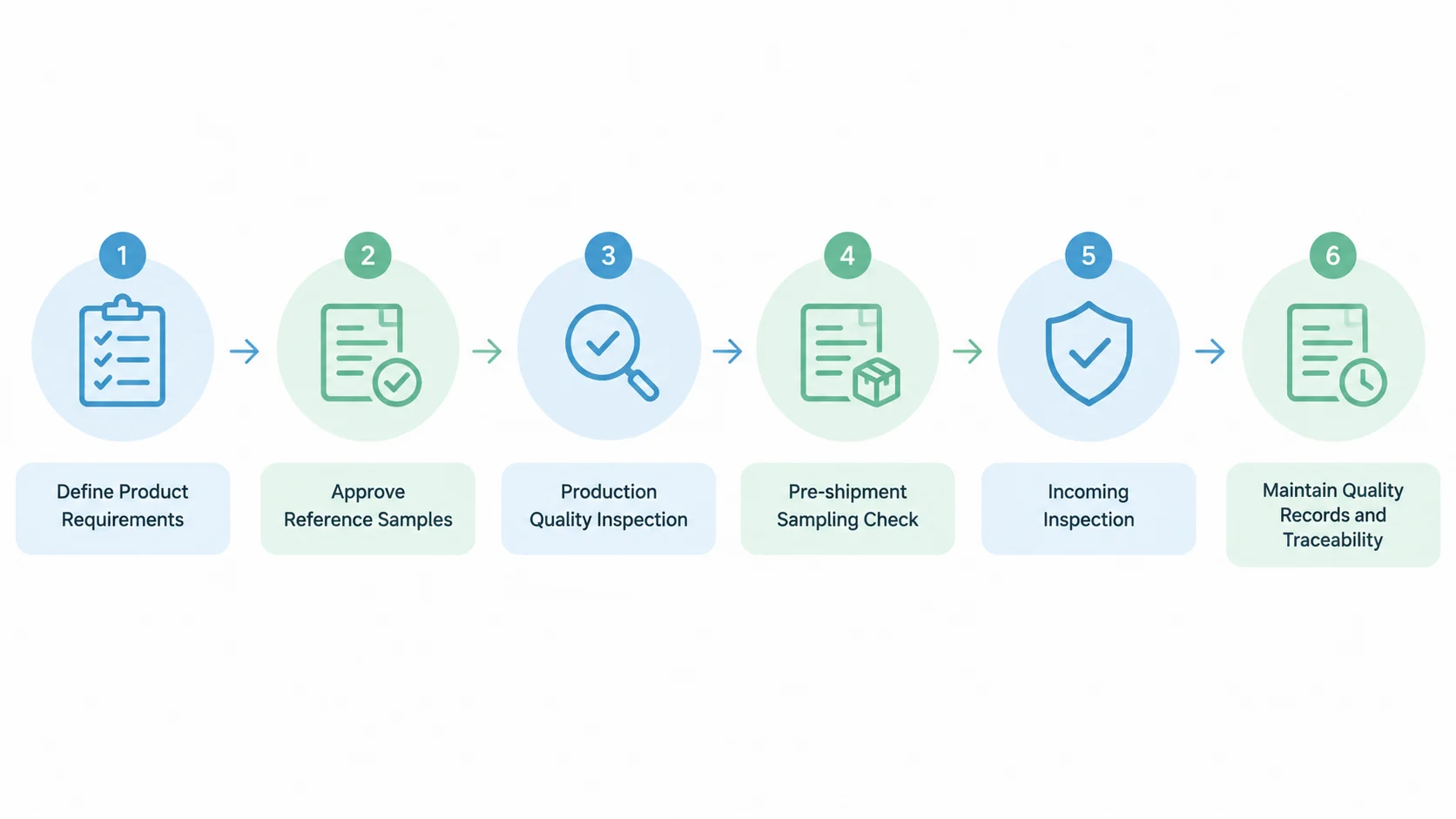
Confirm the written specificationScreen for visible defectsMeasure straightness and dimensionsRecord and decide
1 How to Check Bamboo Skewer Straightness
Short answer
How is straightness checked? In two passes: a quick visual screen against a flat surface, then a measured check against the tolerance in your order. The first pass finds obvious problems; only the second produces a number you can put in a quality record.
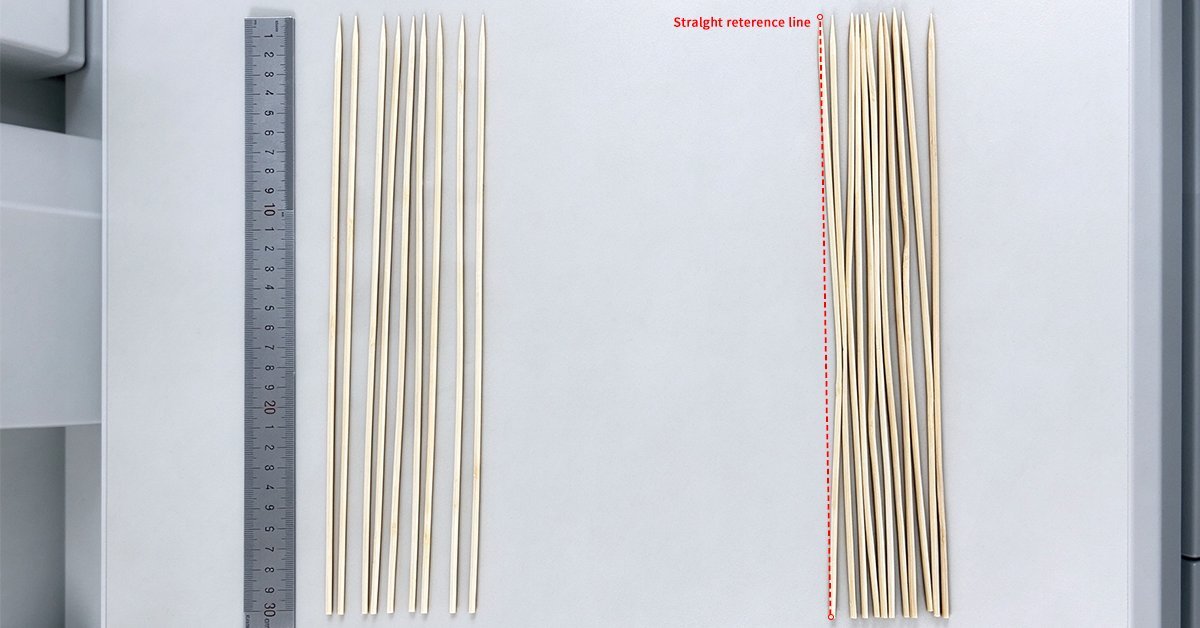
A flat reference surface makes bends and twist visible before any measurement is taken.
Visual Inspection Against a Flat Reference Surface
Place the skewer on a flat, clean surface such as a glass plate or a machined table.
View it from the side at eye level. Look for visible bending, one end lifting off the surface, or twist along the length.
Roll the skewer gently. A skewer that rocks or will not lie flat has a bend or a twist.
Compare several pieces from the same carton. Consistency matters as much as any single piece.
Visual inspection is a screening step. It shows that a skewer is obviously bent; it does not measure how much.
Measuring Straightness or Deviation
Fix the product length, the allowed deviation and the measuring method in the order specification before inspection starts.
Define the measurement basis: how the skewer rests (for example, on its concave side on a flat plate) and what is measured (for example, the maximum gap between skewer and plate, or the lateral offset over a set length). Values from different methods are not interchangeable.
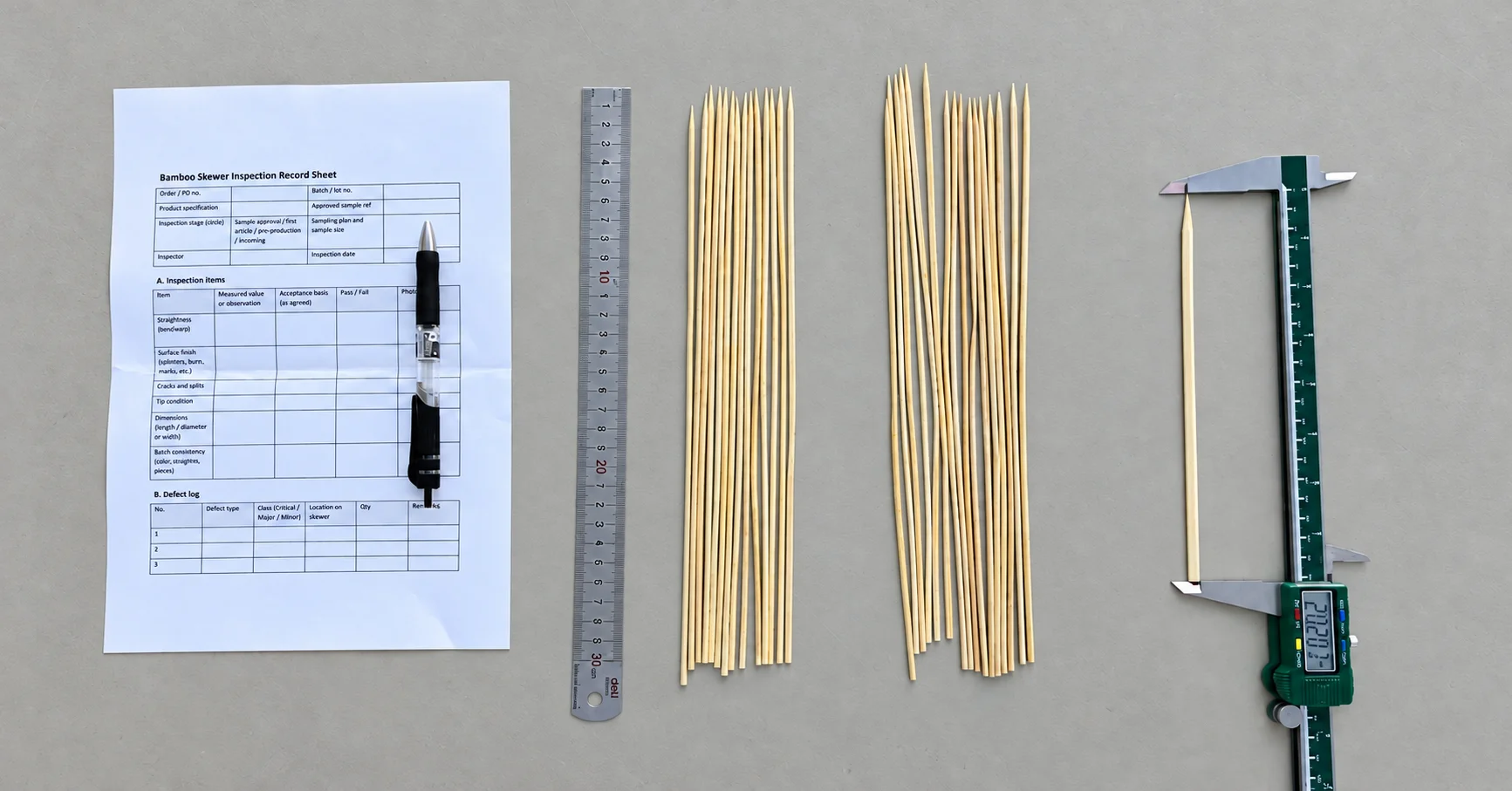
Use the agreed fixture or gauge, such as a flat plate with a feeler gauge or a calibrated straight edge.
Record the deviation in millimetres, with the product specification, inspection date and batch number, not just “pass” or “fail”.
Do not reuse one tolerance across products. A 4.0 mm round skewer and a 6 mm corn skewer need their own limits and methods.
Record the deviation as a number, not as a verdict. A written figure is what lets you compare batches later and support a claim.
Example: Recording Straightness Results
For a 250 mm bamboo skewer order, the inspection record should identify the product specification, the agreed measurement method, the measured deviation and the acceptance limit. If a skewer exceeds the limit, record the result and keep a photo where useful. The 250 mm length is an example only: the allowable deviation must be agreed for the actual product and should not be assumed from length alone.
Record field
Example entry
Product specification
250 mm round skewer, buyer’s specification reference
Measurement method
Agreed method and fixture, written in the order
Measured deviation
Value in mm from that method
Acceptance limit
Limit agreed for this product
Batch number and date
From the carton label; date of inspection
Result and photo
Pass or fail, with a photo of any failed piece
What Can Cause Bamboo Skewers to Bend?
Bending is usually a symptom, and several factors can contribute:
Natural variation in the bamboo raw material
Moisture content changes during drying and storage
Storage and transport conditions, including humidity and loose or uneven packing
Dimensional and shape control during cutting, shaping and polishing
Treat these as possible causes, not a diagnosis. When bent skewers show up in a batch, ask the supplier to review the actual defects and the production and storage records for that batch.
2 How to Inspect Bamboo Skewer Surface Quality
Short answer
How is surface quality inspected? By defect type. Under good light, run through the same four defect groups on every sample, and photograph anything doubtful so the record can be shared with the supplier.
Splinters and Rough Surfaces
Look for raised fibres, burrs or rough patches, especially along edges and near the tip.
Run a gloved finger or a cotton pad along the length. Snagging threads on the pad show a rough surface.
Judge smoothness against the intended use and the approved sample. A skewer for hand-held snacks calls for a stricter finish than one used in industrial food processing.
Cracks, Splits and Surface Damage
Check for longitudinal cracks, split ends, chipped notches and visible breakage.
Separate cosmetic variation, such as slight colour or grain differences, from defects that could affect strength in use, such as a crack running along the skewer.
Set aside suspect pieces, photograph them and note the carton and batch number.
Discoloration and Visible Contamination
Look for unusual spots, strong colour change, stains or foreign matter.
If mould is suspected, isolate the affected cartons and investigate. Do not accept a skewer because the mark wipes off.
Visual inspection cannot replace microbiological or other laboratory testing where your market or customer requires it.
Pointed Tip and End Finish
Check that the tip is complete and shaped consistently across the sample.
Look for split, frayed, off-centre or blunted tips.
Confirm that the tip style matches the order: single point, double point or blunt tip.
Judge each defect group separately: splinters, cracks, surface damage and tip condition.
Classifying Defects After You Find Them
Finding a defect is half the job; the other half is deciding what it means for the shipment. One common framework sorts defects into three classes:
Class
What it means
Examples (confirm per product)
Critical to intended use
Could affect safety or make the skewer unusable
Splinters that can detach, mould or foreign matter, a crack that could break during use
Major
Affects function, strength or the agreed use
Bending beyond the agreed limit, a split or frayed tip, rough patches that snag
Minor / cosmetic
No functional effect and within the agreed appearance range
Slight grain or colour variation, minor surface marks
This is a suggested framework only. Which defect falls in which class, and how many are acceptable, must be agreed between buyer and supplier for the product and its use. Customers do not all apply the same standard.
3 Bamboo Skewer Quality Inspection Checklist
Short answer
How do you use the checklist? Use the same checklist for samples, in-process checks and incoming shipments. It turns each check into a decision by showing what to record and what to judge it against. It is a general framework, not a formal acceptance standard.
Inspection item
What to record
Acceptance basis
Straightness
Measurement and visible defects
Agreed method and tolerance
Surface finish
Splinters, burrs, rough areas
Approved sample and written defect criteria
Cracks and splits
Defect type, location and quantity
Agreed defect classification
Tip condition
Shape, damage and consistency
Approved tip style and appearance standard
Dimensions
Length, diameter or width
Product drawing or specification
Batch consistency
Results across sampled pieces
Agreed sampling and acceptance plan
A real order should also fix the sampling quantity, defect classes, allowed deviations, decision rules and re-inspection process in writing.
Simple Workflow
Confirm the written specification and the approved sample.
Draw the sample according to the agreed sampling plan.
Inspect each item in the table and record results with photos.
Decide against the agreed criteria: release, re-inspect or quarantine.
4 How Many Bamboo Skewers Should You Inspect?
Short answer
How many skewers should you inspect? It depends on the order’s risk, the batch size and the sampling plan both sides agreed. There is no universal figure, so avoid rules of thumb such as “check 5%” or “check 100 pieces” unless they come from an agreed standard. A better approach is to decide what is checked at each stage of the order:
Stage
What to settle or check
Sample approval
Product specification, appearance requirements and measurement method; keep the approved sample as the reference
In-process inspection
Checks scaled to quality risk and the production control plan
Pre-shipment inspection
The batch checked against the agreed sampling plan
Incoming inspection
Checks that reflect arrival risk, transport conditions and contract terms
Record what you measured — the number, the method and the batch — not just a pass or fail.
If you adopt an AQL plan, the sample size comes from the applicable standard, the inspection level, the lot size and the accept/reject numbers. It is not a fixed percentage. Confirm the standard edition and these parameters before they go into the contract, and log any abnormal batch so you can widen the sample or hold the shipment.
Where the sampling criteria come from
AQL is not a percentage you invent. The sample-size letter, the inspection level and the accept/reject numbers come from a published acceptance sampling plan such as ISO 2859-1; the tables and the worked reasoning behind them are set out in the NIST/SEMATECH acceptance sampling reference.
The same family of plans is where the defect classes used in Section 2 come from: judging a lot by attributes means counting critical, major and minor defects against agreed limits, not eyeballing a carton.
Write the plan into the contract — the standard edition, the inspection level and the AQL values — so both sides read the same tables when a batch is disputed.
5 What Should Buyers Include in Bamboo Skewer Quality Requirements?
Short answer
What belongs in the quality agreement? Write the inspection criteria into the order specification or quality agreement as clauses that can be checked, rather than general wording. Refer to the checklist in Section 3 instead of repeating it. The agreement should cover:
Dimensions: length, diameter or width, allowed deviations and the approved sample reference
Straightness: the definition, measuring method and limit
Surface and tip: defect classes and the appearance standard (see Section 2)
Sampling and decisions: the sampling plan, accept/reject rules and re-inspection process
Logistics: packaging, storage, transport and lot traceability
Non-conformance: how failures are notified, isolated, corrected and claimed
Example
Two suppliers may both offer a 250 mm skewer. If only length is specified and neither straightness nor surface is defined, each side can honestly believe its goods conform while the buyer rejects them as bent or rough. Written criteria remove that gap.
Standards and rules buyers can point to
United States: food-contact articles are covered by US FDA 21 CFR Part 174. Ask for a food-contact or migration test report for the finished skewer, not a general statement.
European Union:Regulation (EC) No 1935/2004 sets the general food-contact framework, and for Germany the applicable national rules sit in the LFGB.
Sourcing and traceability: a documented, traceable bamboo source is what FSC chain-of-custody certification is designed to evidence. Ask for the certificate number and the scope it covers, not the logo.
6 Questions to Ask Your Bamboo Skewer Supplier
Short answer
How should you question a supplier? Put these five questions to every supplier you shortlist, and expect a specific answer, not reassurance.
A good answer names the method, the tool or fixture and the tolerance, and says when the check is done.
What surface defects do you classify as unacceptable?
Expect a written defect list, ideally with photos or reference samples.
How do you check consistency across production batches?
Look for comparison against an approved sample and records kept for each batch.
Can you provide inspection records for the relevant product and batch?
The records should name the product and the batch, not be generic.
How do you handle products that fail the agreed inspection criteria?
Expect a clear process for isolating, reworking or replacing, and a notification route.
7 How QL Bamboo Approaches Bamboo Skewer Quality Control
Fujian QL Houseware Manufacturing Co., Ltd (QL Bamboo) makes bamboo skewers in Shaowu, Nanping, Fujian, China. Its bamboo skewer range lists round, square, pointed and paddle styles, with diameter options from 2.0 to 5.0 mm and lengths from 10 to 40 cm, and includes items such as 250 mm disposable skewers, blunt tip 250 mm skewers and 6 mm corn skewers. Because tolerances and finish can differ by product, buyers should confirm the dimensions, tip style, straightness requirement and surface finish for their selected skewer before sample approval.
QL’s published QC system page describes raw material inspection, in-process monitoring and final product inspection, and says its QC laboratory keeps records for each batch. Buyers can use the sampling stage to ask which of these checks apply to their skewer, which acceptance criteria will be used, and which inspection records are available for the relevant batch. QL’s skewer page also states that batches carry lot numbers for traceability, so ask how the lot number appears on the records for your order.
QL Bamboo checks raw material, in-process production and finished goods, with records kept per batch.
Before bulk production, send your specification and agree the inspection method and acceptance criteria with QL, so samples and finished goods are judged against the same requirements. You can send your skewer specification or email ql@qlbamboo.com.
Conclusion: Agree the Criteria Before the Goods Arrive
Bamboo skewer quality is easy to argue about after delivery and far easier to settle when the criteria were written into the order. The checks that carry the most weight are:
Specification → Straightness → Surface → Tip → Dimensions → Sampling → Records → Non-conformance
Confirm the measurement method, the acceptance limits and the records you expect, then judge both samples and finished goods against the same written requirements.
Buying bamboo skewers in bulk and want the inspection method agreed up front? Send your specification, application and target volume, and our team will confirm the tolerance, the tip style and the records available for your order.
Frequently Asked Questions
How can you tell if a bamboo skewer is too bent?
A bamboo skewer is too bent when it exceeds the straightness limit in your specification, measured by the agreed method. Screen by eye on a flat surface, then measure the deviation with the agreed fixture and record the number instead of relying on a visual judgment.
Are small surface imperfections acceptable on bamboo skewers?
That depends on the intended use, the defect type and the appearance standard both sides agreed. Slight grain or colour variation is usually cosmetic, while splinters, cracks and rough patches that affect handling or strength should be defined as defects and limited in writing.
Can visual inspection detect all bamboo skewer quality problems?
No. Visual inspection finds visible defects such as bends, splinters, cracks, stains and tip damage, but it cannot reveal internal flaws or microbiological risk. Add dimensional measurement and, where required, laboratory testing.
Should bamboo skewer quality be checked before or after shipment?
Both, and in between: at sample approval, during production and on arrival. The exact plan depends on the order’s risk and the purchase agreement. Pre-shipment checks help catch problems before goods leave the factory.
What records should buyers keep after inspection?
Keep the order specification, the approved sample record, inspection results, defect photos, batch or lot information and any non-conformance handling record. Together they let you compare batches and settle disputes with evidence.