How to Choose Bamboo Skewer Thickness for Different Foods
- Share
- publisher
- QL Bamboo
- Issue Time
- Nov 27,2026
Summary
Choosing the right bamboo skewer thickness depends on food weight, piercing performance and grilling stability. This guide maps 2.5 mm to 6.0 mm skewers to common foods, with a size chart, testing steps and a wholesale specification checklist.
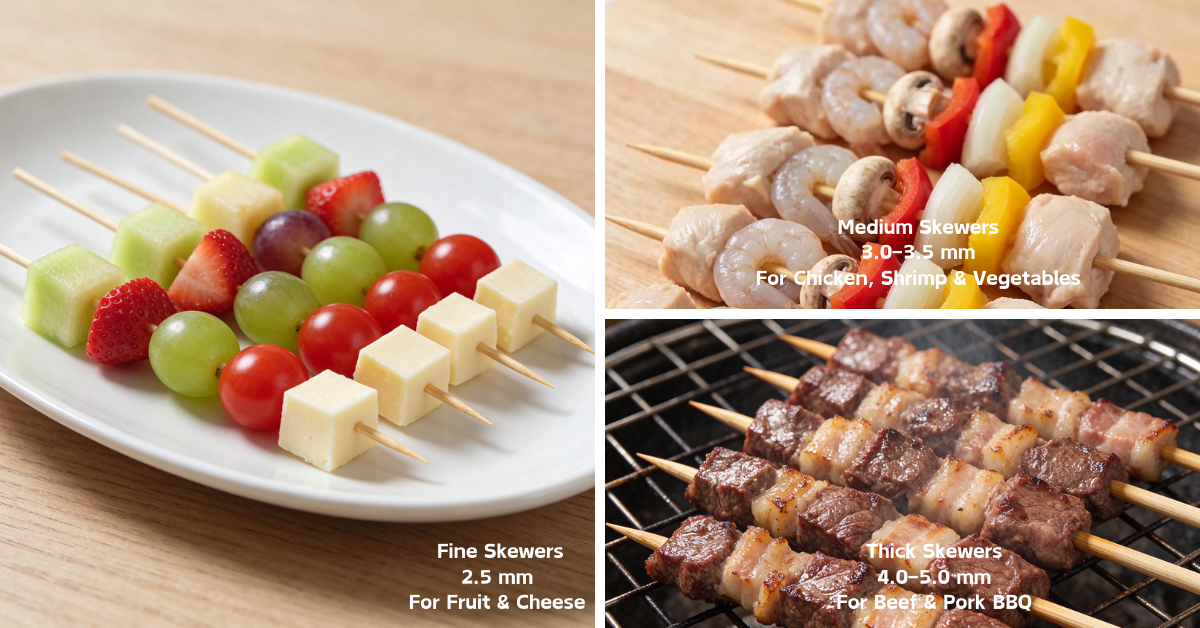
The diameter of a bamboo skewer decides how much weight it can hold, how easily it pierces food, and how stable it stays on the grill. This guide maps skewer thickness — from 2.5 mm fruit picks to 6.0 mm corn holders — to the foods they suit, and shows importers and food service buyers how to test and specify diameter before a bulk order. Skewer thickness is chosen by food weight, not by name. Thin skewers (2.0–2.5 mm) suit lightweight foods such as fruit, cheese and cocktail appetizers; medium skewers (3.0–3.5 mm) suit chicken, shrimp and mixed vegetables; thick skewers (4.0–5.0 mm) suit beef, pork and heavy BBQ portions. A 6.0 mm skewer is a special heavy-duty option for items such as corn on the cob. The right diameter depends on food weight, ingredient density, portion size, and cooking method. For commercial use, confirm the choice with samples tested against your own ingredients and equipment. Bamboo skewer thickness — the diameter for round skewers — affects how the product performs during food preparation, grilling, and serving. Choosing an unsuitable diameter can lead to bending, breakage, difficulty piercing ingredients, or unnecessary damage to food appearance. Thinner skewers suit small, lightweight ingredients. Loaded with large meat portions or several heavy pieces, they bend or break more easily. Thicker skewers provide greater structural support for beef cubes, pork belly, lamb, and larger BBQ portions. A thinner skewer makes a smaller opening and pierces delicate foods such as fruit, shrimp, and small vegetables more cleanly. A skewer that is too thick for the food can split soft or small ingredients. Food is turned and handled repeatedly on the grill. A skewer that is too thin for its load bends, making food hard to turn evenly. A suitable diameter keeps ingredients in position during cooking. Different foods need different levels of support. When selecting bamboo skewers for BBQ, catering, or food processing, consider both the weight of individual ingredients and the total load on each stick. These are application-based recommendations, not fixed industry standards. Confirm the diameter through sample testing with your actual ingredients. Availability depends on the selected product and manufacturing specification. Thin skewers suit lightweight foods that need little structural support. Typical applications include: For catering suppliers, hotels, and restaurants, thinner food picks serve bite-sized portions and improve presentation. A smaller diameter also makes a smaller piercing point, protecting the appearance of delicate ingredients. Medium skewers balance piercing convenience with structural support. They suit applications such as: For standard chicken portions and mixed ingredients, 3.0–3.5 mm is the usual working range; 2.5–3.0 mm suits shrimp and smaller vegetable pieces. Thicker skewers suit larger food portions that need more support. Common applications include: A 4.0 mm skewer is a practical starting point for standard meat kebabs; 5.0 mm is worth testing for larger portions. Thicker skewers reduce bending when food is turned repeatedly during grilling. Some applications call for a larger diameter than standard BBQ skewers. A 6.0 mm skewer is one option for heavier items such as corn on the cob. This size is not needed for ordinary fruit, vegetable, or small meat skewers, and should be confirmed with the manufacturer against the product structure and intended use. Comparing specific diameters makes selection easier. All three work for food applications, but they suit different loads. A 4.0 mm skewer provides more support than a 3.0 mm skewer, but a 3.0 mm skewer suits smaller ingredients that need a smaller piercing opening. A 5.0 mm skewer is not automatically the best choice for every BBQ application — the right diameter matches the food weight, ingredient size, and cooking process. The wrong diameter affects preparation efficiency, product appearance, and consistency across foodservice operations. For food manufacturers and catering businesses, these problems raise handling difficulty and food waste. No. A thicker skewer generally provides more support, but diameter alone does not determine quality. Other factors include bamboo raw material quality, fiber structure and density, straightness, surface smoothness, dimensional consistency, and drying conditions. A well-made 3.0 mm skewer can outperform a poorly processed 4.0 mm one. Diameter is only one part of the specification. Consider these factors before confirming a bulk order. Estimate the weight on each skewer. Three small chicken pieces and several large meat chunks need different support. For mixed kebabs, use the combined weight of all ingredients. Length must match the food portion, cooking equipment, and serving needs. QL Bamboo offers skewers from 150 mm to 400 mm depending on diameter and specification. Two skewers of the same nominal diameter can perform differently if material and processing differ. Check straightness, surface smoothness, tip shape, and diameter consistency against the agreed specification. Charcoal grilling, gas grilling, oven cooking, and cold preparation expose skewers to different heat and handling. Make the cooking method part of sample testing. For importers, caterers, and food processors, testing samples before a large order is the most practical way to confirm specification. Test against your own ingredients and equipment rather than relying on a chart alone. Use the same type, size, and approximate weight of food you use in production or service. Thread the ingredients onto different diameters, keeping the number, size, and arrangement of pieces consistent. Watch whether skewers bend noticeably or split when loaded and handled. Grill or cook the samples with your normal equipment, temperature, and time, and check they stay suitable for turning. Select the specification that gives enough support without making piercing unnecessarily difficult. Before a bulk order, request samples in different diameters and test them with your actual food products and equipment. Record the approved diameter, length, tip style, surface requirements, and dimensional tolerance for repeat orders. Once the thickness is settled, confirm the complete specification with your supplier. Questions to ask a bamboo skewer manufacturer before choosing a supplier: These questions help buyers compare manufacturers on product suitability and consistency rather than price alone. QL Bamboo supplies bamboo skewers in different diameters, lengths, and styles for BBQ, catering, foodservice, and wholesale applications. Our bamboo raw material is FSC-certified, confirming responsible sourcing from managed forests, and we can provide FSC chain-of-custody documentation with your order. Explore the QL Bamboo skewers product range to review available options. For many standard BBQ applications, 3.0–4.0 mm is a practical starting point. Smaller food portions may need thinner skewers, while larger and heavier meat portions may need 5.0 mm. The final choice depends on food weight and cooking conditions. Generally, a larger diameter provides more structural support than a thinner skewer of comparable bamboo material. However, strength also depends on raw material quality, fiber structure, straightness, and manufacturing processes. A 3.0–3.5 mm skewer is a reasonable starting point for standard chicken pieces. For larger chicken chunks or heavier portions, 4.0 mm skewers are worth testing. For small fruit cubes, grapes, and cocktail appetizers, 2.0–2.5 mm skewers are generally suitable. The right diameter depends on fruit size, weight, and the number of pieces per skewer. For larger beef, pork, and lamb portions, 4.0–5.0 mm skewers are useful options to evaluate. A 5.0 mm diameter may suit a skewer that carries a heavier load. A 3.0 mm skewer suits moderate loads and smaller ingredients, while a 4.0 mm skewer provides additional support for larger meat portions and BBQ. The best choice depends on the actual food load and piercing requirements. Sizes vary by manufacturer and specification. QL Bamboo offers bamboo skewer diameters from 2.5 mm to 6.0 mm and lengths from 150 mm to 400 mm. Confirm available diameter and length combinations with the manufacturer. Measure samples from different positions within a production lot using a suitable instrument, then compare against the agreed diameter and tolerance. Straightness, surface splinters, tip condition, and other quality requirements should also be part of the inspection plan. Choosing the right bamboo skewer thickness improves handling, food presentation, and consistency across your foodservice operations. QL Bamboo supplies FSC-certified bamboo skewers in different sizes and styles for wholesale, catering, BBQ, and food manufacturing. Contact our team to discuss your required diameter, length, packaging, and bulk order specifications.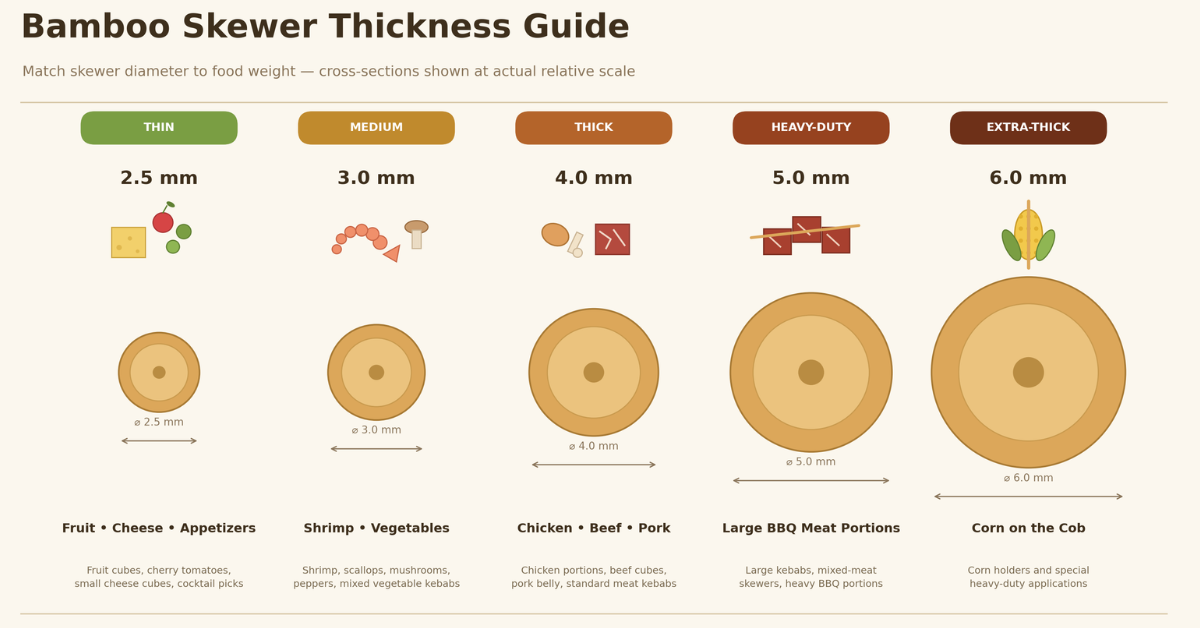
1. Why Does Bamboo Skewer Thickness Matter?
1.1 Load-Bearing Capacity
1.2 Piercing Performance
1.3 Grilling Stability
2. Bamboo Skewer Thickness Chart for Different Foods
Food Type Recommended Diameter Selection Reason Fruit & Cheese 2.0–2.5 mm Lightweight ingredients, easy piercing Shrimp & Seafood 2.5–3.0 mm Delicate ingredients requiring moderate support Chicken Skewers 3.0–3.5 mm Suitable for standard meat portions Vegetable Skewers 2.5–3.5 mm Depends on vegetable size and density Beef & Pork Kebabs 3.5–4.0 mm Better support for heavier meat portions Large BBQ Meat Skewers 4.0–5.0 mm Greater support for larger and heavier portions Corn on the Cob 5.0–6.0 mm Requires stronger support for a relatively heavy item 2.1 Thin Bamboo Skewers (2.0–2.5 mm): For Fruit, Cheese and Appetizers
2.2 Medium Bamboo Skewers (2.5–3.5 mm): For Shrimp, Chicken and Vegetables
2.3 Thick Bamboo Skewers (4.0–5.0 mm): For Beef, Pork and Heavy BBQ
2.4 Extra-Thick Bamboo Skewers (6.0 mm): For Special Heavy-Duty Applications
3. 3 mm vs 4 mm vs 5 mm Bamboo Skewers: What Is the Difference?
Diameter Main Characteristics Typical Applications 3.0 mm Moderate food loads and relatively easy piercing Chicken, shrimp, vegetables 4.0 mm Provides additional structural support Meat kebabs, BBQ 5.0 mm Suitable for heavier food portions Large meat skewers, heavy BBQ 4. What Happens If You Choose the Wrong Skewer Thickness?
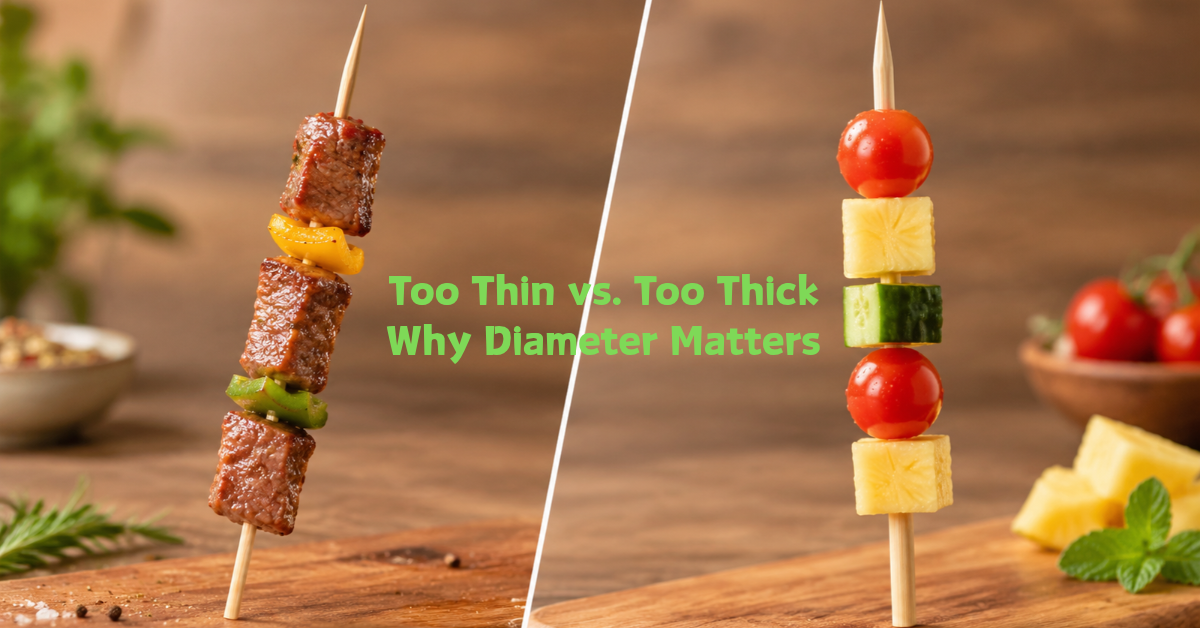
4.1 What Happens When a Bamboo Skewer Is Too Thin?
4.2 What Happens When a Bamboo Skewer Is Too Thick?
4.3 Does a Thicker Bamboo Skewer Always Mean Better Quality?
5. What Other Factors Should You Consider Besides Thickness?
Food Weight and Portion Size
Bamboo Skewer Length
Bamboo Quality and Straightness
Cooking Method
6. How to Test the Right Bamboo Skewer Thickness Before Bulk Ordering
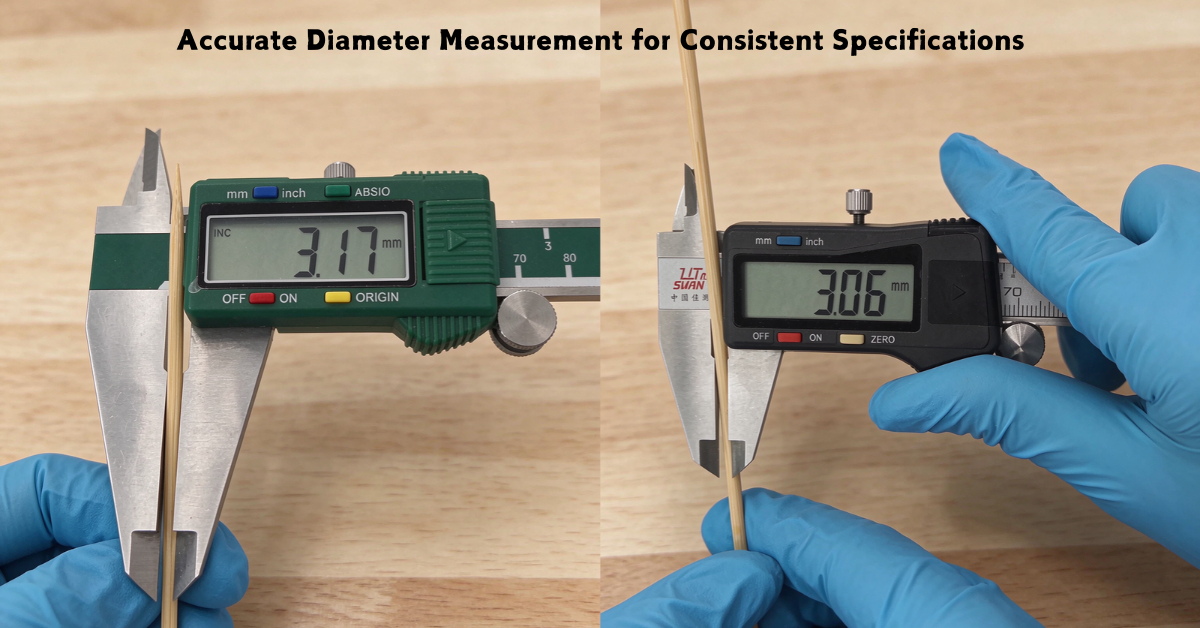
Prepare Your Actual Ingredients
Load the Skewers
Check Bending and Breakage
Test Under Actual Cooking Conditions
Compare Different Diameters
7. Choosing the Right Bamboo Skewer Specifications for Bulk Orders
Specification What to Confirm Diameter 2.0 / 2.5 / 3.0 / 4.0 / 5.0 mm Length 100–400 mm, depending on availability Shape Round, flat or other customized styles Tip Pointed or blunt Surface Smooth finish, free from visible splinters Tolerance Confirm acceptable dimensional variation Packaging Bulk packing or customized retail packaging 8. Frequently Asked Questions About Bamboo Skewer Thickness
What is the best thickness for bamboo BBQ skewers?
Are thicker bamboo skewers stronger?
What diameter bamboo skewer is best for chicken?
What size bamboo skewers should I use for fruit?
What thickness bamboo skewers are best for heavy meat?
What is the difference between 3 mm and 4 mm bamboo skewers?
What bamboo skewer sizes are available for wholesale orders?
How do buyers check bamboo skewer diameter consistency?
Need Bamboo Skewers for Wholesale or Custom Orders?