What Should Buyers Look for in a Bamboo Coffee Stirrer Supplier?
- Share
- publisher
- QL Bamboo
- Issue Time
- Sep 24,2026
Summary
A buyer-focused guide to evaluating a bamboo coffee stirrer supplier: raw material, dimensional consistency, food-contact documentation, sizes, customization, MOQ, lead times and factory verification.
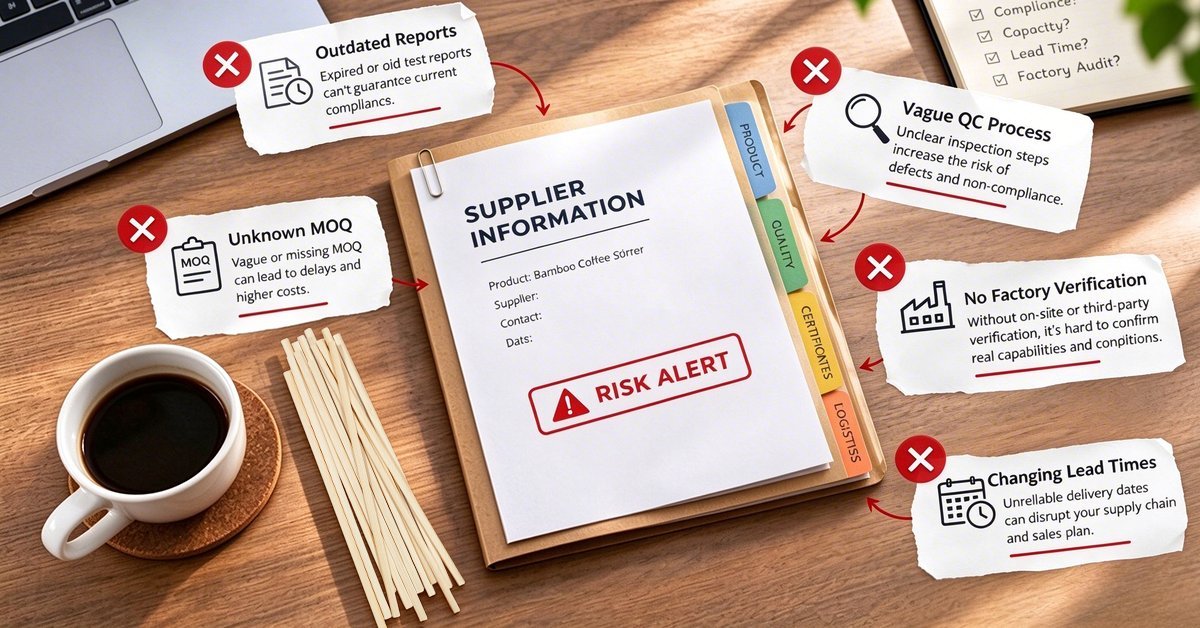
Choosing a bamboo coffee stirrer supplier is not just about comparing a unit price on a quote sheet. For buyers placing recurring orders — coffee chains, cafés, foodservice distributors, importers, and retail brands — the real cost of a bad supplier shows up later: a batch that splinters, a size that doesn't fit the cup line, a compliance document that turns out to be outdated when customs asks for it.
This guide walks through what actually matters when evaluating a bamboo coffee stirrer supplier, organized around the questions a buyer needs answered before committing to bulk volume.
When choosing a bamboo coffee stirrer supplier, buyers should evaluate raw material quality, dimensional consistency, food-contact documentation, available sizes, customization capability, packaging options, MOQ, production capacity, and delivery reliability — together, not in isolation. A supplier that's strong on price but vague on any one of these can still cause problems once volume scales up.
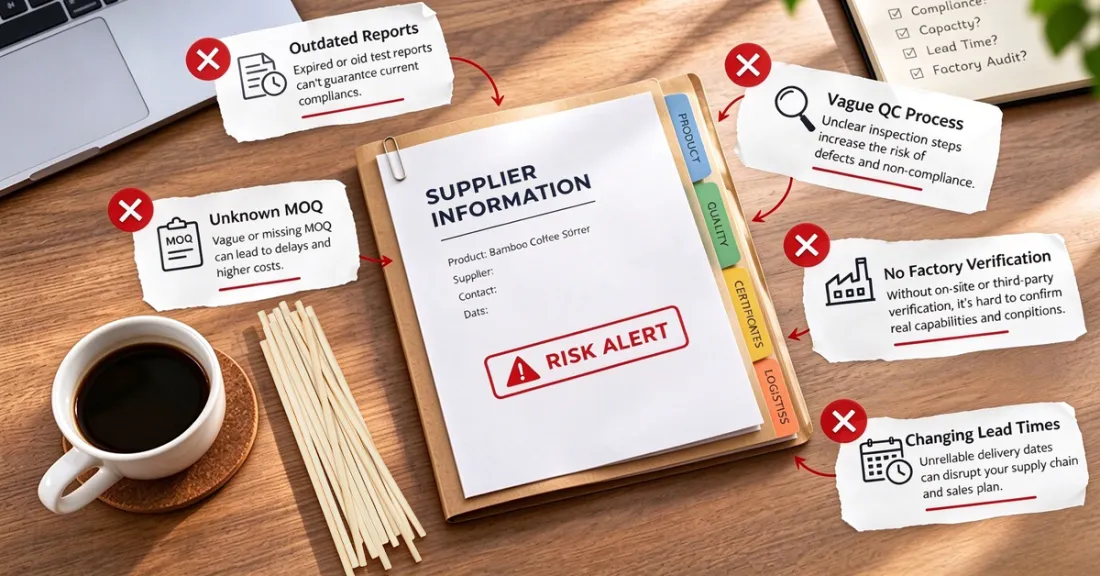
Nine Questions to Ask Before You Commit
Work through these nine questions in order. Each one targets a failure point that only becomes visible after volume scales — which is exactly when switching suppliers is most expensive.
1Is the Bamboo Itself Suitable for Coffee Stirrers?
The bamboo species, maturity, and drying process directly affect how strong, smooth, and consistent the finished stirrer is — this is where quality problems usually start, not in the cutting stage.
What to Check
- Bamboo species and where it's sourced
- Maturity of the raw material (younger bamboo is softer and more prone to splitting)
- Moisture control during drying
Questions to Ask
- What type of bamboo do you use, and where does it come from?
- How is moisture controlled before processing?
- Is the raw material sourced from your own supply, or bought from third-party traders?
That last question matters more than it sounds. A supplier with direct access to its raw material may have greater control over sourcing, material selection, and supply consistency than one relying on multiple third-party sources — though the real test is still what the supplier can document about its process. QL, for example, sources bamboo from its own 666-hectare forest in Nanping, Fujian, and uses moso bamboo matured over five years — giving buyers a clear reference point for where its raw material comes from and how it's selected.
2Can the Supplier Hold Consistent Size and Surface Quality?
For high-volume beverage programs, small variations in length, thickness, or surface finish aren't cosmetic — they affect how stirrers dispense, pack, and perform in the cup.
What to Check
- Length and thickness tolerance
- Straightness and surface smoothness
- How defective pieces are identified and removed
Questions to Ask
- What dimensional tolerances can you consistently maintain?
- At what stage is quality inspected — only at the end, or throughout production?
- How do you handle a batch that doesn't meet spec?
Splintering can result from several factors — raw material quality, moisture control, cutting, and surface finishing all play a role. That's why it's worth asking specifically how a supplier controls and inspects the finished surface, rather than simply asking whether the product is "smooth."
3Can the Supplier Meet Your Market's Food-Contact Requirements?
Food-contact requirements differ by destination market, so the useful question isn't "is it food safe" in general — it's which specific standards apply to your market and whether the supplier can document compliance for the actual product you're ordering.
What to Ask For
- Current test reports, not outdated ones
- Confirmation the reports cover the actual product/material, not a generic company certificate
Questions to Ask
- Which food-contact standards does this specific product meet?
- Can you provide test reports dated within the last year?
- Are these reports for this product, or for your company in general?
Be cautious of a supplier that answers with a blanket "FDA approved" and nothing else. A supplier that can point to specific, current, product-level documentation is giving you something you can actually show a customs officer or a retail buyer's compliance team. QL, for reference, can provide food-contact testing and compliance documentation relevant to applicable SGS, FDA, and LFGB requirements for its bamboo coffee stirrers — but the habit of asking for the actual reports, rather than taking a claim at face value, is worth applying to any supplier you're evaluating.
- United States: food-contact substances under FDA 21 CFR Part 174
- European Union: framework requirements in Regulation (EC) No 1935/2004
- Germany: national food and feed code LFGB
- Sustainable sourcing: chain-of-custody certification FSC®
4Does the Supplier Offer the Right Size for Your Application?
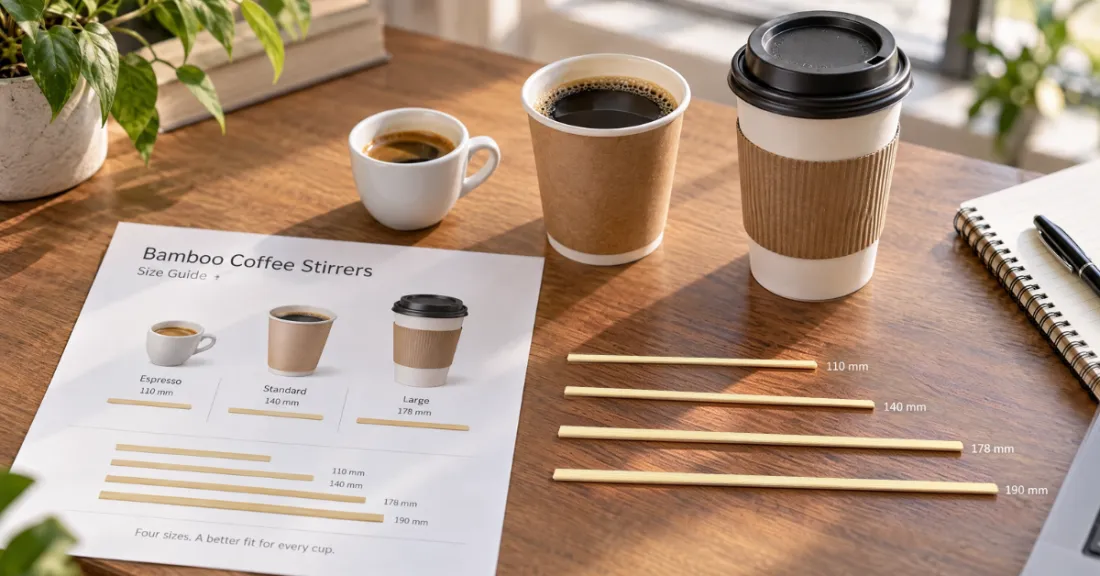
"Coffee stirrer" isn't one product — the right length depends on cup size and how the stirrer will be dispensed, and a supplier's size range tells you a lot about how specialized they actually are in this product category.
Common bamboo coffee stirrer lengths run from around 90mm up to 190mm:
| Length | Typical Use |
|---|---|
| 90–105mm | Vending machine applications, depending on dispenser design |
| 110mm | Small/espresso cups |
| 140mm | Standard coffee cups |
| 178–190mm | Takeaway and larger beverage cups |
- Which size fits my cup format?
- Can length or thickness be customized outside your standard range?
- Do you offer a dedicated version for vending machines?
Vending machine stirrers are a good example of a size buyers often overlook until they hit a problem — dispenser slot width and feed mechanism vary between machines, so the right size depends on the specific equipment being used, not just a general rule of thumb. Suppliers who've thought this through usually offer a purpose-built vending size rather than the same stick for every application — QL, for instance, offers 90 x 9 x 1.3mm and 105 x 9 x 1.3mm vending stirrers for this kind of use.
5Can the Supplier Handle Customization and Private Label?
For branded beverage programs, standard bulk product often isn't enough — buyers may need a specific length, a logo, or packaging built around their own brand.
What Can Typically Be Customized
- Length and thickness within the manufacturer's production range
- Logo customization
- Packaging format and branding
Questions to Ask
- What's the size range for custom dimensions?
- Is there a separate MOQ for custom branding versus standard product?
- Is there a sample fee for custom logo samples, and is it refundable on bulk order?
It's worth asking that last question directly, because policies vary a lot between suppliers — some charge for every custom sample, others only charge a small fee that's credited back once you place a bulk order. QL, for example, offers custom sizing (11cm to 19cm) with logo engraving and branded packaging as part of its OEM/ODM service, and applies a small, order-refundable fee to custom-logo samples.
6Does the Supplier Offer Packaging That Fits Your Distribution Model?
Packaging isn't an afterthought — it needs to match how the product actually reaches the end user, whether that's a barista scooping from a bulk bag or a vending machine dispensing individually wrapped sticks.
Packaging Options Buyers Commonly Need
- Individually wrapped (hygiene-focused, common for cafés and vending)
- Bulk bag (cost-efficient for high-turnover foodservice use)
- Branded box (retail and gifting presentation)
Questions to Ask
- What packaging formats do you offer?
- Can packaging quantities be adjusted to my order size?
- Can cartons carry my own labeling for customs and distribution?
A supplier offering only one packaging format is a sign they're set up for a narrow customer base. QL, for example, offers individually paper-wrapped, bulk PE bag, and premium branded box packaging for its coffee stirrers — a range built to serve both foodservice and retail channels rather than just one.
7Can the Supplier Support Your Order Volume — Now and Later?
A supplier should be able to handle not just your first order, but your repeat orders, without quality or lead time slipping as volume grows.
What to Check
- Minimum order quantity (MOQ)
- Monthly production capacity
- How repeat and peak-season orders are scheduled
Questions to Ask
- What is the MOQ for standard versus custom orders?
- What's your realistic monthly output for this product?
- How do you plan for a buyer's recurring, ongoing orders rather than one-off ones?
MOQs for bamboo coffee stirrers can run high for standard product (six figures in unit count isn't unusual), so it's worth clarifying this early rather than discovering it after negotiations are already underway. Warehouse and export capacity can provide useful context when assessing whether a supplier is set up for recurring bulk orders, but buyers should still confirm product-specific production capacity for their own item. QL, for example, operates a 10,000 sqm warehouse with roughly 7,500 pallet positions and exports more than 700 containers annually — figures that provide context for its broader bulk-order and export operations, while capacity for a specific product should still be confirmed per project.
8Are Lead Times and Delivery Terms Clearly Defined?
A reliable supplier gives a lead time based on your actual specification, order volume, and season — not the same number for every inquiry regardless of what's being ordered.
What to Check
- Sample lead time versus bulk production lead time
- How peak-season demand affects scheduling
- What typically causes delays
Questions to Ask
- What's the realistic bulk production time for my specification?
- What factors could extend that timeline?
- How are repeat orders scheduled against new customer orders?
If a supplier quotes the exact same lead time regardless of quantity, customization, or season, it's worth asking what that number is actually based on.
9Can You Verify How the Supplier Actually Manufactures?
Factory visibility gives buyers a practical way to verify where and how a product is actually manufactured — and it's one of the easier things to check before placing a large order.
What Buyers Can Ask to See
- Raw material processing and drying
- Cutting, polishing, and quality inspection stages
- Packaging and finished-goods storage
Questions to Ask
- Can I see production videos or a live factory tour?
- Do you support third-party factory audits?
- Are you operating this production yourself, or is it produced through another arrangement?
This is worth confirming directly rather than assuming. A supplier that operates its own production site should be able to explain where and how the product is made, and provide reasonable evidence of its manufacturing arrangements — whether that's factory footage, a live video call, or audit access.
What Should Buyers Ask a Bamboo Coffee Stirrer Supplier?
Print this checklist and work through it supplier by supplier. A supplier that can answer all nine without hesitation is worth a sample request.
- What bamboo species is used, and where is it sourced?
- What sizes are available, including for vending machines?
- What dimensional tolerances can you consistently hold?
- What current, product-specific food-contact documents can you provide?
- What customization options exist, and what's the MOQ for each?
- What packaging formats do you offer?
- What is your standard MOQ, and your realistic monthly capacity?
- What is the production lead time for my specification?
- Can I verify your factory directly?
Bamboo Coffee Stirrer Supplier Red Flags
- Sample and bulk product don't match. The sample that impressed you should be representative of what actually ships at volume.
- No control over approved samples. If a supplier doesn't maintain a clear reference sample or specification for bulk production, it becomes difficult to confirm that what ships matches what you originally approved.
- Vague answers on quality control. "We check everything" isn't a process — ask where inspection actually happens.
- Outdated or unclear compliance documents. A report from several years ago, or one that doesn't specify the product, isn't usable documentation.
- MOQ and lead time keep shifting. If the numbers change every time you ask, the supplier likely doesn't have a firm handle on their own capacity.
- No clear answer on where the product is made. A supplier who can't explain their own production location or process makes it harder to verify what you're actually buying.
- Prices with no specification behind them. A low quote without a defined size, material, or packaging isn't comparable to anything — it's just a number.
Bamboo Coffee Stirrer Supplier Evaluation Checklist
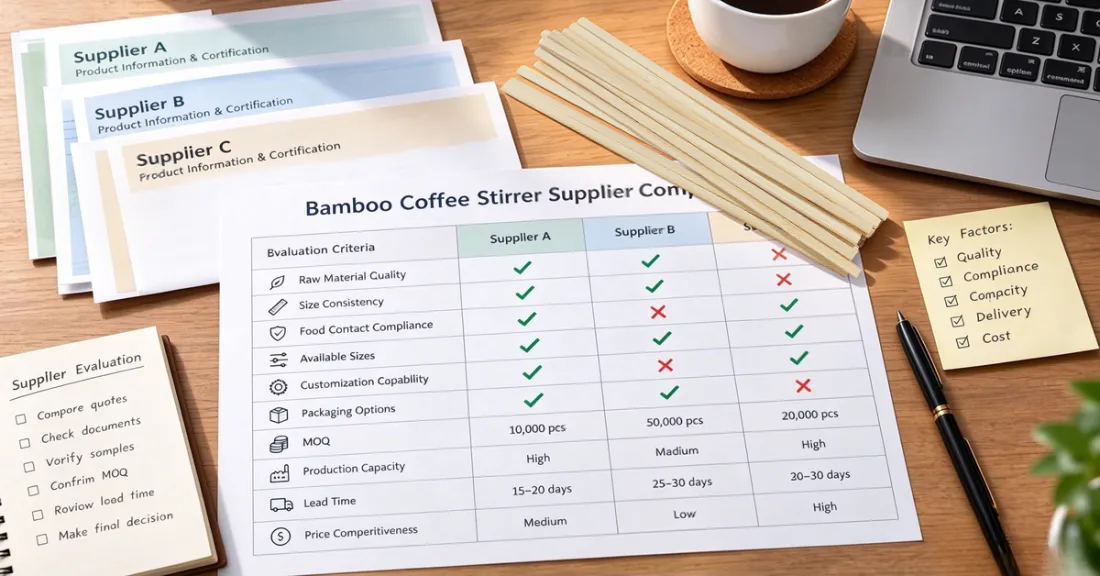
Use this table to compare suppliers side by side, and to decide what evidence to request before you move to a bulk quotation.
| What to Evaluate | What to Ask | Evidence to Request |
|---|---|---|
| Raw material | What bamboo is used, and how mature? | Material sourcing information |
| Dimensions | What tolerances are maintained? | Specification sheet + approved sample |
| Surface quality | How are products inspected? | Inspection criteria + sample |
| Food-contact compliance | Which standards apply to my market? | Current, product-specific test reports |
| Sizes | Does it fit my cup and dispensing setup? | Product size chart |
| Customization | Can size, logo, packaging be adjusted? | Sample with custom spec |
| Packaging | Does it match my distribution channel? | Packaging options list |
| MOQ & capacity | Can repeat orders be supported? | Production/capacity information |
| Lead time | Is the timeline realistic for my order? | Production schedule |
| Factory transparency | Can production be verified? | Factory video or audit access |
Frequently Asked Questions
What should I ask a bamboo coffee stirrer supplier before ordering?
Start with raw material sourcing, dimensional tolerances, current food-contact test reports, MOQ, and how production is verified. These questions help buyers assess product consistency, compliance, production capability, and supplier transparency before comparing quotations.
What size bamboo coffee stirrer should I choose?
It depends on your cup format: 110mm for small/espresso cups, 140mm for standard coffee cups, 178–190mm for takeaway or larger drinks, and a dedicated 90–105mm size for vending machines, depending on the dispenser's design.
Are bamboo coffee stirrers food safe?
Bamboo coffee stirrers intended for food contact should be evaluated against the requirements applicable to the destination market. Buyers should request current, product-specific test reports and compliance documents — such as testing relevant to FDA or LFGB requirements — rather than relying on a general "food safe" claim.
What documents should I request from a bamboo coffee stirrer supplier?
Product-specific food-contact test reports, a dimensional specification sheet, and — for larger orders — factory audit access or production footage.
What is the MOQ for custom bamboo coffee stirrers?
This varies by supplier and by how much customization is involved (size versus logo versus full custom packaging). Ask for MOQ broken down by customization type rather than a single blanket number.
Can bamboo coffee stirrers be customized?
Yes — length, thickness, logo, and packaging are commonly customizable within a manufacturer's production range, though MOQ and lead time typically increase with the level of customization.
How long does it take to manufacture bamboo coffee stirrers?
Lead time depends on specification, order volume, and season. Ask the supplier to explain what their quoted lead time is based on — including specification, quantity, packaging, and current production schedule.
How can I verify a bamboo coffee stirrer manufacturer in China?
Ask for live production video, a scheduled video call to the factory floor, or third-party audit access.
What Matters Most When Comparing Suppliers?
If you are shortlisting three suppliers and have limited time, use this priority order to decide where to push hardest for evidence.
| Priority | What Buyers Should Confirm |
|---|---|
| Product | Material, size, thickness, surface quality |
| Compliance | Applicable market requirements and current test reports |
| Customization | Size, logo, packaging, MOQ |
| Supply | Production capacity and repeat-order capability |
| Delivery | Realistic lead time and shipping readiness |
| Verification | Factory, QC process, approved sample |
How Does QL Bamboo Fit These Evaluation Criteria?
For buyers evaluating QL Bamboo against the criteria above: the company manufactures bamboo coffee stirrers in 110mm, 140mm, 178mm, and 190mm standard lengths, plus dedicated vending-machine sizes (90 x 9 x 1.3mm and 105 x 9 x 1.3mm).
Its bamboo is sourced from its own 666-hectare forest in Nanping, Fujian, using moso bamboo matured over five years. OEM/ODM services cover custom sizing (11cm–19cm), logo engraving, and multiple packaging formats.
Buyers can request the relevant product specifications, food-contact documentation, packaging details, and production information for their specific project.