What Makes a Bamboo Coffee Stirrer Suitable for Vending Machines?
- Share
- publisher
- QL Bamboo
- Issue Time
- Nov 11,2026
Summary
Most automatic coffee dispensers take a 90 x 9 x 1.3 mm or 105 x 9 x 1.3 mm bamboo stirrer held to +/-0.2 mm. This guide covers the six specifications that decide whether a stick dispenses, the packaging that loads without re-orientation, a 300-cycle machine trial with a zero-fault pass mark, and the food-contact documents worth asking for.

Automatic dispensers release one stick at a time, and that single mechanical action is where most vending stirrer problems begin. This guide sets out the sizes that actually fit machine magazines, the tolerances worth writing into a purchase order, a 300-cycle test you can run on your own dispenser, and the documents to ask for before a container is booked.
Reviewed by the QL Bamboo vending-supply team · Last updated: November 2026. Dimensions and tolerance bands below are production specifications for machine-grade stirrers; moisture figures are windows to agree with your supplier rather than universal values. Re-check the slot geometry of your own machine before committing to a container, and treat every figure here as the starting point for a written specification rather than a substitute for one.
The two stick sizes that fit most automatic coffee dispensers are 90 × 9 × 1.3 mm and 105 × 9 × 1.3 mm, held to ±0.2 mm. Anything longer than about 110 mm is normally a manual cup stirrer, not a vending stirrer — a shortened 140 mm café stick is not a substitute for either size.
Before you place a bulk order, run 300 dispense cycles in your own machine at 25%, 50% and 100% magazine fill. Consistent individual release, not appearance, is the specification that matters: a single jam in 300 cycles is already 0.33%, which at 500 cups a day means more than one service event daily. The pass mark for a sample trial is therefore zero jams and zero double-feeds.
Key Takeaways
- Vending stirrers are a separate size class. 90 × 9 × 1.3 mm and 105 × 9 × 1.3 mm. A shortened 140 mm café stick is not a substitute for either.
- Write ±0.2 mm on thickness into the purchase order. Thickness variation shows up first as double-dispensing, long before anyone notices a bent stick.
- Measure 30 sticks per batch at three points each. A single sample tells you nothing about a 20,000-piece carton.
- Test at three magazine fill levels, 300 cycles minimum, and log every fault. The pass mark for a sample trial is zero jams and zero double-feeds.
- Food-contact paperwork is a market-entry document, not a quality claim. Ask for the report number and the scope it covers, not a logo.
- One export carton holds 20,000 pieces. Inner packs of 1,000 or 2,000 pieces set your order quantities.
What Is a Bamboo Coffee Stirrer for Vending Machines?
A bamboo coffee stirrer for vending machines is a flat, disposable bamboo stick held in an internal magazine and released one at a time by a mechanical or gravity-fed dispensing system.
It differs from a café stirrer in one respect that decides everything else: it is a machine-handled part, not just a drink accessory. The machine has a slot, a feed channel and a separator, and the stick has to pass through all three thousands of times without an operator present.
A machine-handled part, not a drink accessory
A vending-ready bamboo stirrer therefore needs seven things, and appearance is not one of them:
- Length, width and thickness inside a defined tolerance band — not merely close to nominal.
- A flat, straight profile that stacks without wedging.
- Smooth, splinter-free surfaces that slide rather than grip.
- Enough rigidity to stir without snapping at 1.3 mm thickness.
- Controlled moisture, so sticks do not swell, warp or mould in storage.
- Bundled packaging that loads into a magazine without re-orienting every stick.
- Batch-to-batch consistency, because the machine is calibrated once.

This matters commercially. A jammed dispenser stops the machine, triggers a service call and, in pay-per-cup sites, loses revenue for the operator. For vending manufacturers, coffee roasters and office coffee service (OCS) distributors, the cost of a bad batch is measured in service visits, not in the few cents saved per stick.
The dimensions below are production specifications. The tolerance bands and moisture figures are the values to write into a purchase order, and both should be re-checked against your own machine’s slot geometry before you commit to a container.
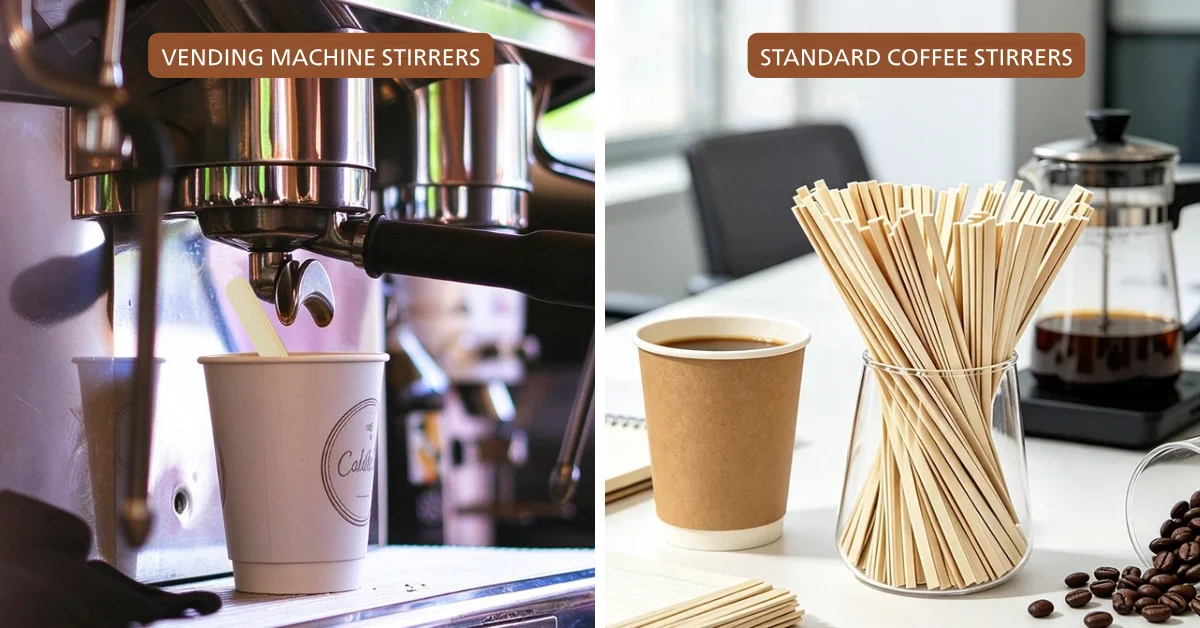
Vending stirrers sit in their own size class
Most sourcing errors come from treating “coffee stirrer” as one product. It is not. Length is set by the dispensing method and the cup, and the vending class is the shortest one.
| Dispensing method | Typical stick size | Where it is used |
|---|---|---|
| Automatic vending dispenser | 90 × 9 × 1.3 mm or 105 × 9 × 1.3 mm | Coffee, tea and soup vending machines; OCS accounts |
| Manual stirring, espresso or small cup (up to ~180 ml) | 110 × 9 × 1.3 mm | Café counters, office kitchens |
| Manual stirring, standard takeaway cup (240–350 ml) | 140 mm | Takeaway, QSR, convenience retail |
| Manual stirring, large iced or bubble-tea cup (500 ml+) | 178 mm or 190 mm | Iced drinks, foodservice |
The 110 mm, 140 mm and 178–190 mm lengths are manual-use lengths. They will sit in a vending magazine and may even feed, but the geometry they were polished for is a cup, not a dispenser slot. The 90 mm and 105 mm range is produced specifically for machines, at 9 mm width and 1.3 mm thickness.
Bamboo, birch or plastic: what actually differs
Material choice changes the failure modes you have to manage, not the mechanical requirement.
| Property | Bamboo | Birch / hardwood | Plastic (polystyrene) |
|---|---|---|---|
| Hot-liquid rigidity | High; bamboo is a dense grass and does not soften at drink temperatures | High | Depends on grade; some soften in very hot liquids |
| Dimensional consistency | Good when cut and sorted to ±0.2 mm | Good | Excellent — moulded to shape |
| Splinter risk | Low after multi-stage polishing | Moderate; grain lifts if sanding is skipped | None |
| Moisture sensitivity | Present; requires drying and a moisture specification | Present | None |
| End of life | Compostable | Compostable | Limited recycling, single-use restrictions in some markets |
| Machine compatibility | Requires tolerance control on thickness | Requires tolerance control on thickness | Consistent by default |
Bamboo’s practical advantage for vending is that it is stiff at 1.3 mm without being brittle, and it is a fast-renewing material. Its practical disadvantage is that it is a natural material, so consistency has to be engineered through cutting, drying, sorting and polishing rather than assumed.
If material choice is still open on your project, our comparison of bamboo and plastic stirrers covers how each behaves in hot liquid, in storage and under single-use rules in different markets.
Six Requirements That Decide Whether a Vending Stirrer Dispenses
Six specifications decide whether a bamboo coffee stirrer works in an automatic vending machine. Length sets fit, thickness sets separation, flatness sets stacking, surface finish sets friction, moisture sets stability, and food-contact documentation sets market access. Everything else is secondary.
Dimensions and tolerances: what should you specify?
Dimensions are the first filter. A stick that is 0.3 mm too thick will not separate cleanly; a stick that is 2 mm too long will not sit in the magazine.
Nominal size is not a specification on its own. Vending buyers should approve a tolerance band per axis, and the band should be tighter than the machine’s clearance, not equal to it.
| Dimension | Production spec for vending stirrers | Tolerance to write into the order | Why it matters |
|---|---|---|---|
| Length | 90 mm or 105 mm | ±0.5 mm | Magazine length and drop clearance |
| Width | 9 mm | ±0.3 mm | Feed channel width; the stick must not rotate |
| Thickness | 1.3 mm | ±0.2 mm | The separation gap between adjacent sticks |
| Straightness (bow) | Flat | ≤0.5 mm over the full length | Prevents sticks wedging into a stack |
| End squareness | Square cut | ≤1 mm deviation | Uneven ends catch on the release gate |
Thickness is the dimension that causes the most vending failures and receives the least attention. Separation mechanisms are designed around a gap: if the gap is set for 1.3 mm sticks and a batch arrives at 1.5 mm, the gate either opens on two sticks or blocks entirely. Both fault modes look like a machine problem and are usually a product problem.
Before production, give the manufacturer the nominal size and the tolerance, and state how you will measure it. “9 × 1.3 mm” without a tolerance and a gauge method will be interpreted differently by every factory you ask.
Flatness: how much bow is too much?
A flat, unwarped stick stacks predictably. A bowed stick stacks at an angle, and an angled stack is what jams a channel.
Bending is a manufacturing outcome, not a raw-material accident. It comes from cutting green bamboo before it has stabilised, from uneven drying, or from polishing one face more than the other. A supplier that controls drying has far less bow than one that only inspects for it.
Check during sample inspection:
- Whether sticks lie flat on a glass surface with no visible rock.
- Whether maximum bow, measured with a feeler gauge, stays under 0.5 mm.
- Whether width is constant along the full length, not just at the ends.
- Whether thickness is uniform across the middle and both edges.
- Whether both ends are cut square and at the same angle.
- Whether any stick shows a twist rather than a simple curve — twist is the harder defect to sort out.
Flatness matters most in machines with narrow magazines, where a 1 mm bow is enough to change the stack angle. It matters least in short, wide gravity magazines — which is why the same defect can pass one customer’s trial and fail another’s.
Surface finish: how smooth does a vending stirrer need to be?
Surface quality is both a user-safety issue and a feeding issue. Rough faces increase friction between sticks; loose fibres catch on the release gate; a splinter becomes a complaint.
A finished vending stirrer should present:
- Smooth faces on both sides, with no raised grain.
- Cleanly cut edges with no torn fibres.
- No visible splinters, chips or crush marks.
- No cracks, checks or dark streaks in the wood.
- A consistent finish across the batch, not just in the top layer of the bundle.
Multi-stage polishing is what produces this: a coarse pass to true the profile, then finer passes to close the grain. Polishing has to be controlled, because over-polishing removes material and reintroduces the thickness variation the cutting line just eliminated. The two processes have to be tuned against each other, which is a factory discipline rather than a machine setting.
A practical field check: draw a cotton swab along both edges and both faces of ten sticks. Any fibre that lifts onto the cotton is a fibre that will lift in a cup.
Feeding and dispensing: why do stirrers jam or double-feed?
Meeting the dimensional specification does not guarantee smooth feeding in a vending machine, because the machine contributes half the system. Gravity magazines, spring-loaded pushers, rotating separators and gate-style release mechanisms all stress the stick differently.
The common faults and their product-side causes:
| Feeding problem | Product-related cause | What to check first |
|---|---|---|
| Jamming in the channel | Thickness over spec, bow over 0.5 mm, width variation | Thickness at three points, 30 sticks |
| Double dispensing | Thickness inconsistency across the batch, not the mean | Within-batch spread, not the average |
| Failure to release | Stick too long or too short for the gate travel; square-cut ends missing | Length against the machine drawing |
| Irregular feeding | Surface friction differences, loose fibres, mixed lengths in one bundle | Batch mixing at packing |
| Sticks breaking in the magazine | Moisture too low (brittle) or a cross-grain defect | Moisture reading and break test |
How can buyers evaluate feeding performance? Run the trial as a measurement, not an impression:
- Load 200–300 sticks into the magazine of the actual machine model you will use.
- Test at three fill levels — 25%, 50% and 100% — because a full magazine loads the separator differently from a nearly empty one.
- Run a minimum of 100 cycles at each level, 300 cycles in total.
- Log every event: jam, double dispense, failed release, broken stick.
- Repeat with a second batch from a different production date.
- Calculate failures per 100 cycles and compare against the figure agreed with your machine supplier.
Do the arithmetic before you set the pass mark, because the tolerance is far tighter than it looks. A 300-cycle trial can only resolve faults down to about 0.3%, and 0.3% is already far too high in production: at 500 cups a day, 0.33% is more than one jam a day. That is why the acceptance criterion for a sample run is zero jams, zero double-feeds and zero failed releases across all three fill levels — a single event is a finding to investigate, not statistical noise to average away.
Never substitute a generic test rig for the real machine. Slot width, gate travel and magazine angle differ enough between models that a stick which passes on one dispenser can fail on another from the same brand.
Packaging: how should vending stirrers be packed?
Packaging is part of the dispensing system. A bundle that has to be re-oriented by hand at every refill adds labour to every shift, and hand re-orientation is also where mixed lengths get introduced.
Standard vending packing for this size class:
| Level | Typical configuration | Note |
|---|---|---|
| Bundle | 50 pcs per bundle | Fits a magazine refill in one motion |
| Inner box | 50 bundles per box = 2,500 pcs | Alternative: 1,000 or 2,000 pcs per inner pack |
| Export carton | 8 boxes per carton = 20,000 pcs | Alternative: 20 inner packs of 1,000 pcs |
| Materials | PE, OPP or CPP bag; paper box; carton | Heat-sealed for transit |
Confirm five things before mass production:
- Bundle count, and whether the bundle drop-loads into your magazine without re-orientation.
- Whether the bag opens cleanly without tearing into the product.
- Whether sticks stay aligned and square through transit and warehouse handling.
- Whether the pack resists dust and moisture in humid storage.
- Whether the inner-pack count matches your replenishment cycle — 2,500 pcs per box suits high-volume OCS routes; 1,000 pcs suits smaller operators.
Individual wrapping is not required for machine loading and adds cost per unit. It is worth it only when the distribution model requires it — hotel amenity trays, retail shelf packs, or markets where the stick is handled before it enters the machine.
Food contact: which documents are required?
A stirrer goes into a hot drink and then into someone’s mouth, so food-contact status is a hard requirement rather than a marketing point. It is also the requirement most often evidenced by a logo instead of a document.
Two different kinds of paper get mixed up here, and keeping them apart is what makes a supplier conversation useful. Regulations are market-entry requirements that no factory “holds”. Certificates are issued to a factory, and they cover a system, not a product.
| Document | What kind of paper it is | What it governs |
|---|---|---|
| 21 CFR Part 174 (US) | Regulation — a market-entry requirement | Whether the material may contact food in the United States |
| Regulation (EC) No 1935/2004 | Regulation — a market-entry requirement | General framework for food-contact materials in the EU |
| LFGB (Germany) | National law — a market-entry requirement | The food and feed code many EU buyers test against |
| FSC® chain of custody | Certificate held by the supplier | Documented, traceable fibre source — not food safety |
| ISO 9001 | Certificate held by the supplier, if it has one | Process control behind consistency claims — not a product test |
A certification logo is not a product test. ISO 9001 describes a factory’s quality system; it says nothing about whether a specific stick is food-contact compliant. FSC® describes fibre provenance, not food safety. Neither substitutes for a migration or sensory test report on the finished product.
Bamboo is a natural material, so the test report has a scope. Ask which product, which batch and which test standard the report covers, and whether it is still in date. A report for a 140 mm unpolished skewer does not cover a 105 × 9 × 1.3 mm polished stirrer.
Also check, physically:
- Bamboo species and maturity — mature culm (three years or older) is denser and holds a 1.3 mm profile better than young bamboo.
- Clean surfaces with no staining, dust or storage marks.
- No foreign odour, and no chemical smell from treatment or storage.
- Evidence that drying and moisture control are part of the process, not a final inspection.
- Batch coding, so a complaint can be traced to a production run.
Our companion piece on the food-safety documents importers should ask for walks through how to read those reports line by line.
How to Choose the Right Bamboo Coffee Stirrer Size
There is no single bamboo stirrer size for all vending machines, but there is a reliable starting point: 90 mm and 105 mm, at 9 mm width and 1.3 mm thickness, fit the majority of automatic coffee and tea dispensers in Europe, North America and Asia. Everything else is either a manual cup length or an OEM size.
Work through four decisions in this order.
Length — start from the machine, then the cup
Ask the equipment manufacturer for the magazine length and the gate travel, not the stick size they recommend. Two machines with the same “recommended 105 mm” can have different gate clearances. If you have no drawing, measure the magazine interior with a caliper and use the shorter of the two standard lengths that clears it.
Width — 9 mm is the vending standard
Width controls whether the stick can rotate in the channel. A narrower stick can turn and present its edge to the gate; a wider one binds. Do not trade width for a marginal raw-material saving.
Thickness — 1.3 mm, and this is where the money is
Thickness sets the separation gap and the break strength at the same time. Going thinner to save material increases breakage in the cup; going thicker to increase strength causes double-feeds. Specify 1.3 mm with a ±0.2 mm band and hold the supplier to it.
Shape and end design — flat, square-cut, no bevel
Flat sticks are the vending norm. Bevelled or rounded ends look better but change how the stick sits against the release gate, so any change of end profile needs a fresh machine trial.
Vending stirrer specification checklist
| Specification | What to confirm | Vending reference value |
|---|---|---|
| Length | Required stick length and tolerance | 90 mm or 105 mm, ±0.5 mm |
| Width | Acceptable width range | 9 mm, ±0.3 mm |
| Thickness | Required thickness and tolerance | 1.3 mm, ±0.2 mm |
| Straightness | Maximum permitted bow | ≤0.5 mm over full length |
| Shape | Flat profile and end design | Flat, square-cut |
| Surface | Smoothness and splinter control | Two-stage polish, no lifting fibre |
| Moisture | Agreed moisture window | Typically 8–12%; agree one figure and a test method |
| Material | Species and maturity | Agreed species, mature culm (3 years or older), no staining |
| Packaging | Bundle, inner box, carton counts | 50 pcs/bundle, 20,000 pcs/carton |
| Documentation | Food-contact reports for the market | 21 CFR 174 / 1935/2004 / LFGB as applicable |
| Testing | Sample approval and machine feeding test | 300 cycles, 3 fill levels, zero-fault pass mark |
Two practical notes on this table. First, the moisture figure is a range because the right value depends on your storage climate — a humid warehouse needs a drier stick than a climate-controlled one, and the supplier cannot pick that for you. Second, the tolerance column is where price differences between quotes usually hide: two suppliers quoting “105 × 9 × 1.3 mm” may be working to ±0.2 mm and ±0.5 mm respectively, and only one of them will feed.
How to Test Bamboo Coffee Stirrers Before Bulk Ordering
A pre-production trial on bamboo coffee stirrers for vending machines should produce numbers you can put next to a purchase order. Four stages, run in this order, separate product defects from machine incompatibility — which is the whole point, because the two demand different responses.
Before you start: request at least 300 sticks from the sample batch, and if possible samples from three different production dates. Batch-to-batch drift is the failure mode that a single good sample cannot reveal.
Step 1: dimensional inspection
Measure, do not eyeball.
- Take 30 sticks at random from the sample, drawn from at least three bundles.
- Measure length at the centre line, width at three points (both ends and middle), and thickness at three points across the width.
- Record every reading; compute the mean and the maximum deviation per axis.
- Check straightness on a flat glass surface with a feeler gauge and record maximum bow.
- Accept only if at least 95% of readings sit inside the tolerance band and no single reading exceeds it by more than 50%.
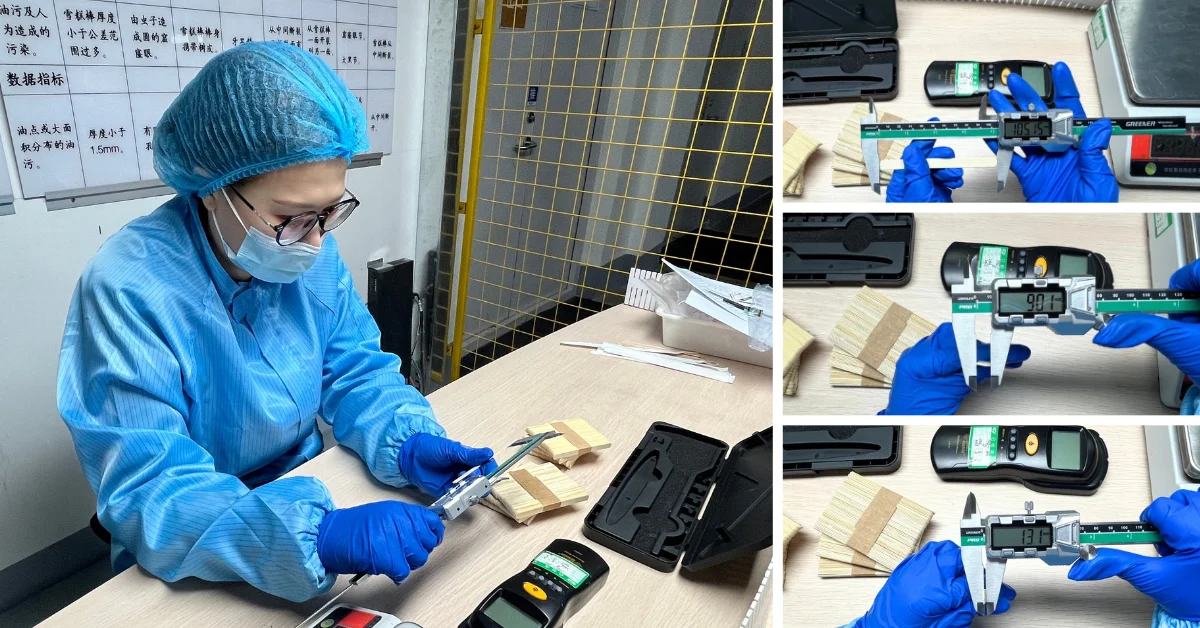
Thirty sticks is the minimum that shows a spread. Ten sticks will tell you the mean is right; it will not tell you the batch is consistent, and consistency is the entire specification.
Step 2: surface and appearance inspection
Inspect against a defect classification rather than a general impression:
| Defect class | Examples | Disposition |
|---|---|---|
| Critical | Visible mould, staining, foreign matter, chemical odour, cracks through the section | Reject the batch |
| Major | Splinters, torn edges, bow over 0.5 mm, thickness outside tolerance, mixed lengths in one bundle | Sort or reject by AQL |
| Minor | Slight surface roughness, minor colour variation, small polish marks | Accept within AQL |
Use AQL 2.5 for major defects and AQL 4.0 for minor defects on a general inspection level II sample, and write those figures into the order. Without a stated AQL, “we inspect every carton” is a claim you cannot verify and cannot enforce.
Step 3: actual vending machine feeding test
This is the stage that decides the order.
- Load 200–300 sticks into the real machine model.
- Run 100 cycles each at 25%, 50% and 100% magazine fill.
- Log every jam, double-dispense, failed release and broken stick, with the cycle number.
- Repeat the run with a second batch from a different production date.
- Record ambient conditions — a cold warehouse changes how a natural material feeds.
| Faults in 300 cycles | Failure rate | Commercial read | Decision |
|---|---|---|---|
| 0 | Below 0.3% | Consistent with a machine-grade stick | Accept, then re-run to confirm |
| 1 | 0.33% | More than one fault a day at 500 cups | Investigate the fault mode, then re-run |
| 2 | 0.67% | Unusable in production | Reject the batch |
| 3 or more | 1% and above | Product or specification problem | Reject and re-specify |
If failures cluster at full magazine, suspect thickness spread. If they cluster at low fill, suspect bow or surface friction. If they are random across fill levels, suspect length against gate travel. Each pattern points at a different fix, and a supplier that can read the pattern is worth more than one that offers a discount.
Step 4: hot beverage use test
Finally, test the stick the way the customer will use it.
- Immerse in coffee at 85–95 °C for five minutes, five sticks at a time.
- Stir for 30 seconds and check for softening, delamination or snapping.
- Re-measure straightness after immersion; bamboo that bows in the cup was dried unevenly.
- Smell and taste a plain hot water sample stirred with the stick — any woody, sour or chemical note is a sensory failure, not a preference.
- Check that the surface stays comfortable to hold and does not raise fibres when wet.
A stick that passes stage 3 and fails stage 4 has a moisture or polishing problem, not a dimensional one. That distinction tells you what to ask the factory to change.
How Manufacturers Keep Bamboo Vending Stirrers Consistent
Consistency in a bamboo coffee stirrer is manufactured in five stages and then verified in a sixth. Skipping any one of them shows up as a vending fault three months later, after the container has landed.
Raw bamboo selection
Mature culm, correct species, no staining or insect damage. Maturity matters mechanically: young bamboo is softer and will not hold a 1.3 mm profile through polishing. The species and harvest age belong on the specification, not in the factory’s discretion.
Precision cutting and profile forming
Automated cutting holds length, width and thickness to a repeatable band — in vending production, a deviation of under 0.2 mm is the working target. Manual cutting on bamboo cannot hold that across tens of thousands of pieces, which is why the machine-grade size class is normally produced on automated lines.
Drying and moisture control
Bamboo is hygroscopic: it takes on and gives off moisture with the environment. Too wet, and sticks swell, warp or mould in a humid container. Too dry, and they become brittle and snap at 1.3 mm thickness. A controlled drying step plus a moisture specification of roughly 8–12%, measured on a defined sample, keeps a shipment stable from factory to warehouse.
Multi-stage polishing
Coarse pass to true the profile, finer passes to close the grain and remove lifting fibre. Polishing must be tuned against cutting, because over-polishing removes the material that the tolerance depends on. This is the stage where a supplier either controls two variables together or quietly loses one of them.
Sorting and quality inspection
Dimensional sorting, visual sorting and rejection of bent or irregular sticks. Sorting is what converts a “mostly good” batch into a dispenser-ready one, and it is also the step most often skipped when a factory is under delivery pressure.
Batch management
Production records and batch codes that let a complaint be traced to a run, a raw-material lot and a date. For a buyer running annual contracts, batch traceability is what makes a corrective-action conversation possible instead of a blame exchange.
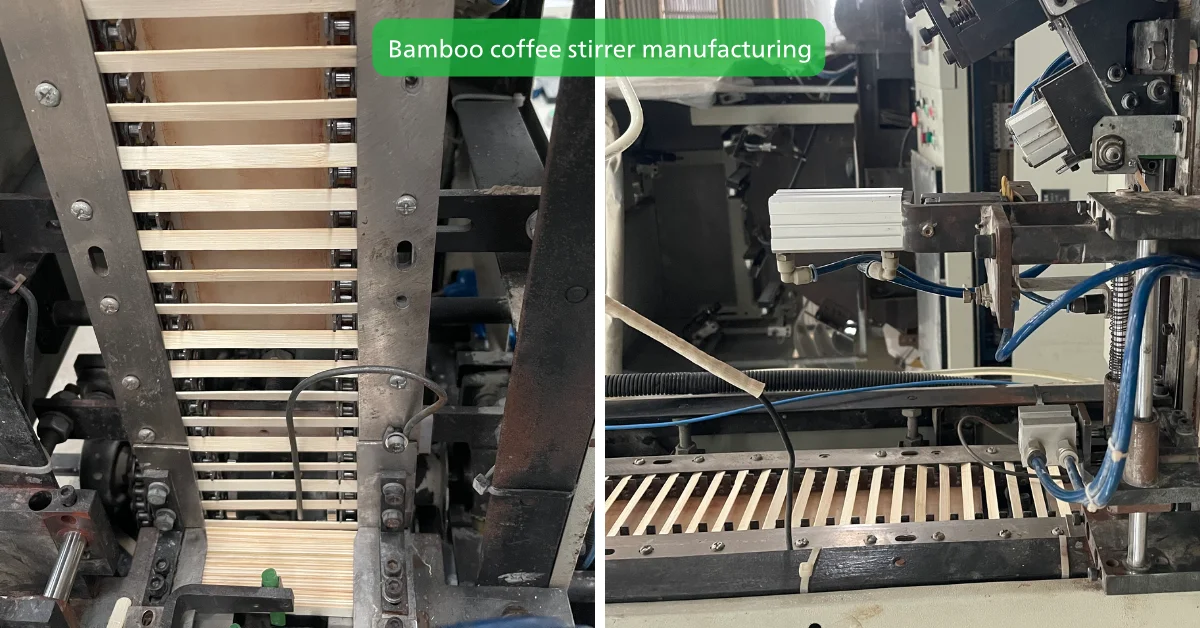
For large-volume purchasing, ask three specific questions rather than “do you have quality control”. What is your cutting tolerance, and how is it measured? What moisture figure do you ship at, and how is it tested? Can I see an inspection record for a batch comparable to mine? The answers separate manufacturers from traders very quickly.
What Should Buyers Look for in a Vending Stirrer Manufacturer?
Choosing the product is half the sourcing decision. The other half is choosing a supplier that can hold the same tolerance on the tenth order as on the sample.
Vending stirrers sit at the awkward end of the bamboo product range: small, cheap per unit, and mechanically demanding. That combination punishes suppliers who are set up for volume alone, because the tolerance is what costs money, not the bamboo.
| What to check | Questions to ask | What a good answer sounds like |
|---|---|---|
| Manufacturing capability | Do you operate your own cutting, drying and polishing lines? | Names the processes and the site, not a trading address |
| Dimensional control | What tolerance can you hold, and how is it measured? | A number (±0.2 mm) and a gauge method |
| Surface quality | How many polishing stages, and how is lifting fibre checked? | A stage count and a physical check, not “very smooth” |
| Machine compatibility | Can you supply free samples for a machine trial? | Yes, with a stated sample quantity |
| Customisation | Can length, width, thickness and packing be changed? | A stated custom range, for example 110–190 mm |
| Documentation | Which food-contact reports exist for this size? | A named standard, a batch scope and a date |
| Bulk supply | Can you hold the same specification across repeat orders? | Batch codes and inspection records |
A supplier worth scaling with will talk about separation gaps and moisture figures. One that only sends a catalogue and a price list is selling a commodity, and a commodity is exactly what jams a dispenser.
Before mass production, confirm in writing:
- Final product specification with tolerances and test method.
- Approved pre-production sample, retained by both sides.
- Machine feeding test results, including the failure count.
- Packaging configuration: bundle, inner box, carton and materials.
- Inspection criteria and AQL levels.
- Production lead time, shipment schedule and batch coding.
Keep the approved sample. When a later shipment is disputed, the retained sample is the only evidence both sides accepted in advance.
QL Bamboo: Wholesale and OEM Bamboo Coffee Stirrers
QL Bamboo manufactures disposable bamboo catering products for international wholesale markets, including machine-grade bamboo stirrers for vending and office coffee service.
Based in Nanping, Fujian, QL combines bamboo raw-material supply with automated cutting, drying and multi-stage polishing — the four processes that decide whether a 1.3 mm stick dispenses reliably. The operation draws on more than 666 hectares of company bamboo forest, an 88,600 m² factory with 138+ automatic machines and a 10,000 m² warehouse, and the company has supplied catering and foodservice buyers for more than 16 years.
Vending stirrer range
Vending stirrers are produced in 90 × 9 × 1.3 mm and 105 × 9 × 1.3 mm, cut and polished to a ±0.2 mm tolerance and sorted to remove bent or irregular sticks. Standard packing is 50 pcs per bundle, 50 bundles per inner box and 8 boxes per export carton — 20,000 pieces per carton — with 1,000 or 2,000 pcs inner-pack options for smaller replenishment cycles.
For buyers who need a longer stick for manual service, the same factory produces 110 mm bulk stirrers and individually wrapped stirrers in 110, 140, 178 and 190 mm at 5 × 1.5 mm, and custom lengths across an 11–19 cm range. The reasoning behind the 110 mm manual length is set out in our 110 mm guide.
Certification and food-contact documentation
QL Bamboo holds FSC® chain-of-custody certification for its bamboo supply, so the bamboo in our stirrers can be traced back to a documented source. Food-contact test reports and declarations are supplied with the order for the size and destination market you specify — ask for them with your enquiry and we will send the ones that match.
What buyers can specify
- Dimensions: length, width and thickness within the custom range, matched to the machine’s slot geometry.
- Tolerance: a stated band per axis, with the measurement method agreed up front.
- Surface finish: multi-stage polish and sorting to remove lifting fibre and bent sticks.
- Packaging: bundle count, inner-pack count, bag material (PE / OPP / CPP), paper box, private-label print.
- Documentation: food-contact reports and inspection records for the destination market.
- Supply: container-load planning — a 20GP holds an estimated 1,000–2,000 inner packs depending on packing format.
- OEM/ODM: private-label packaging and customised product requirements.
Samples are supplied free of charge for machine trials, which is the stage worth spending time on before committing to a container.
Frequently Asked Questions About Bamboo Coffee Stirrers for Vending Machines
What size bamboo stirrer is used in coffee vending machines?
Most automatic coffee and tea dispensers take a 90 × 9 × 1.3 mm or a 105 × 9 × 1.3 mm stick. These two sizes cover the majority of vending and office coffee machines in Europe, North America and Asia. Longer sticks, such as 110 mm or 140 mm, are manual cup stirrers and usually feed poorly in a magazine.
Should I choose 90 mm or 105 mm stirrers?
Choose the longest stick that clears your magazine and gate travel. 105 mm is the safer default for standard dispensers and gives users more stirring length; 90 mm suits compact machines and small cups. Where the machine drawing is available, compare it against both sizes before deciding — the difference in feed reliability is larger than the 15 mm suggests.
Are bamboo coffee stirrers compatible with all vending machines?
No. Dispensing mechanisms differ in slot width, gate travel and magazine angle, so a stick that feeds perfectly in one model can jam in another from the same brand. Compatibility has to be proven on your machine: run 300 cycles at three fill levels and count the faults before approving a bulk order.
What thickness should a bamboo vending machine stirrer have?
1.3 mm is the working thickness for vending stirrers, specified with a tolerance of about ±0.2 mm. Thickness sets the separation gap between adjacent sticks, so variation is more damaging than a slightly different nominal value. Thinner sticks snap in the cup; thicker sticks produce double-dispensing.
Why do bamboo coffee stirrers get stuck in vending machines?
The most common product-side causes are thickness variation across a batch, bow over 0.5 mm, width variation that lets sticks rotate in the channel, and torn edges that catch on the release gate. Machine maintenance, magazine overfilling and humid storage contribute as well. Measure 30 sticks before blaming the machine.
What dimensional tolerance should I write into the purchase order?
Specify ±0.5 mm on length, ±0.3 mm on width and ±0.2 mm on thickness, plus a maximum bow of 0.5 mm over the full length. Always state the measurement method and sampling plan alongside the figure, because a tolerance without a gauge method is interpreted differently by every factory that quotes it.
What moisture content should bamboo stirrers have?
Agree a moisture window, commonly 8–12%, and a test method. Moisture above the window risks swelling and mould during humid transit; moisture below it makes 1.3 mm sticks brittle. The right figure depends on your storage climate, so agree it with the supplier and verify it in the incoming inspection record.
Are bamboo stirrers safe for hot coffee?
Yes, when the bamboo is food-contact grade and properly dried and polished. Bamboo is dense and stiff at drink temperatures and does not soften like some plastics. Ask for the test report that covers this specific size and batch and check it against your market's framework, such as 21 CFR Part 174, EU 1935/2004 or LFGB.
Do bamboo coffee stirrers affect the taste of a drink?
A properly processed bamboo stirrer should add no taste or odour. A woody, sour or chemical note indicates a drying, storage or treatment problem rather than the material itself. Test by stirring plain hot water with five sticks for 30 seconds and smelling and tasting the water before accepting a batch.
Can bamboo vending stirrers be customised?
Yes. Length, width, thickness, end profile and packaging can be customised, and custom lengths are commonly produced across an 11–19 cm range. Any change to thickness or end profile changes how the stick meets the release gate, so a fresh machine trial is required before mass production.
How are bamboo vending stirrers packed, and what is the minimum order?
Standard vending packing is 50 pcs per bundle, 50 bundles per inner box and 8 boxes per export carton, which is 20,000 pieces per carton; 1,000 and 2,000 pcs inner packs are also used. Minimum order quantities are usually worked back from inner-pack counts, so ask for a figure against your own packing format.
How many stirrers fit in a 20-foot container?
A 20GP holds an estimated 1,000–2,000 inner packs, depending on the inner-pack count and carton configuration. At 1,000 pcs per inner pack that is already more than a million sticks, so container planning usually follows annual demand rather than a single order. Ask the supplier for a loading calculation against your specific packing.
How do you test bamboo stirrers before bulk ordering?
Measure 30 sticks on three axes, check straightness on glass with a feeler gauge, then load 200–300 pieces into the real machine and run 300 cycles across three fill levels. Finish with a five-minute immersion test in coffee at 85–95 °C. Accept the batch only if the run finishes with zero jams, zero double-feeds and zero failed releases.
What should I send a manufacturer when requesting a quotation?
Send the machine model or the magazine and slot dimensions, the required length, width and thickness with tolerances, the end profile, the packaging configuration, estimated annual quantity, destination market and any document requirements. A physical reference stick that already dispenses well is the single most useful thing you can send.
How can I find a reliable wholesale bamboo coffee stirrer supplier?
Look for a manufacturer that runs its own cutting, drying and polishing, quotes a tolerance with a measurement method, offers free samples for a machine trial and can show batch-level inspection records. Confirm the food-contact reports cover the exact size you are buying, then approve production only after your own dispensing test.
Appendix: Vending Stirrer RFQ Sheet
Copy this into your enquiry. Suppliers who answer all eleven lines are usually the ones who can hold a specification.
| Item | Your requirement |
|---|---|
| Machine make and model | |
| Magazine length / slot width / gate travel (mm) | |
| Stick length and tolerance | |
| Stick width and tolerance | |
| Stick thickness and tolerance | |
| Maximum permitted bow | |
| End profile | |
| Moisture content and test method | |
| Packaging: bundle / inner box / carton counts | |
| Food-contact reports required for market | |
| Estimated annual quantity and shipment schedule |
Final Takeaway
A bamboo coffee stirrer that works in a vending machine is a small precision part, not a commodity stick. The three numbers that decide whether it dispenses are 90 or 105 mm long, 9 mm wide and 1.3 mm thick, held to ±0.2 mm and confirmed by a zero-fault, 300-cycle trial in your own machine.
For buyers, the sequence that avoids expensive mistakes is short: get the slot geometry from the machine manufacturer, write the tolerance and the moisture window into the specification, measure 30 sticks and run 300 dispense cycles before approving bulk production, and keep the approved sample against later shipments.
Working with a manufacturer that can quote a tolerance, control moisture and supply machine-grade samples turns a recurring machine fault into a settled specification — which is the difference between buying sticks and buying uptime.
Looking for a bamboo coffee stirrer manufacturer for your vending machine project? Send your machine model or slot dimensions, required stick size and tolerance, packaging preference and target market. QL will quote against the specification rather than against a catalogue size — and the sample that comes back is the one to run through your dispenser before you approve production.
Explore QL vending stirrers