Are Bamboo Skewers Food Safe? Documents Importers Should Ask For
- Share
- publisher
- QL Bamboo
- Issue Time
- Oct 30,2026
Summary
Bamboo skewers can be food safe, but only documentation that names your SKU proves it. The documents to request, what EU and US rules actually require, and how to check a supplier before bulk ordering.
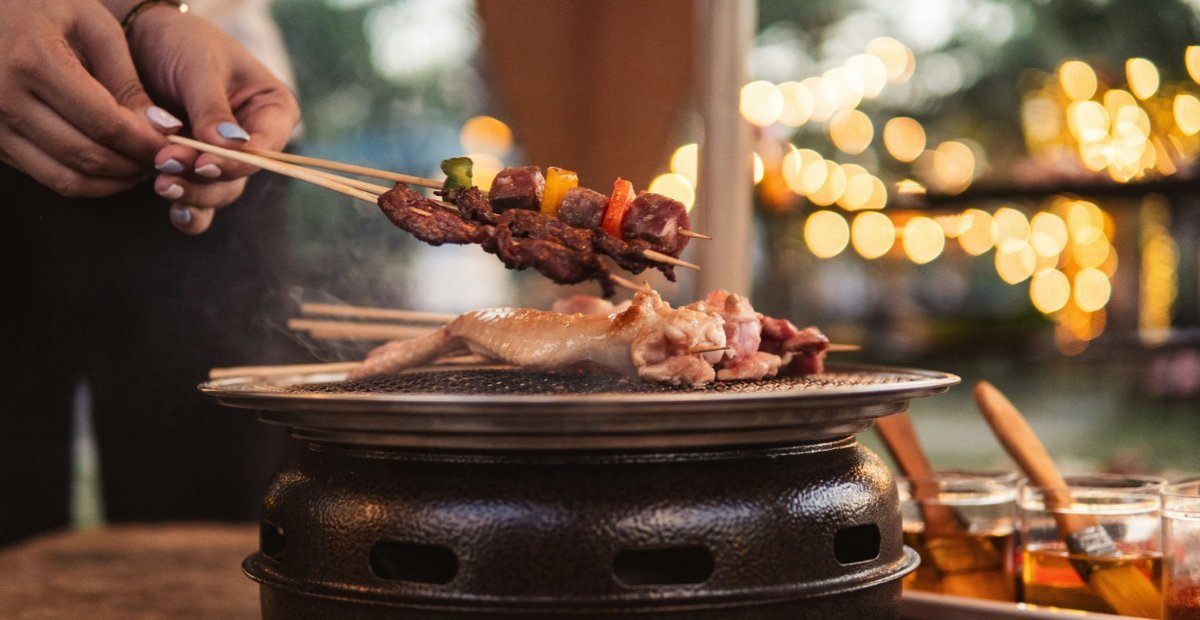
You already have a quotation, a sample on the desk and a folder of documents you are not sure how to read. This guide shows which bamboo skewer documents actually prove something, which only look like they do, and what EU and US food-contact rules really require.
Most people searching this question are not starting from zero. You already have a quotation, maybe a sample on your desk, maybe a container booked — and a folder of documents you are not entirely sure how to read. A certificate with no product name. An ISO logo. A test report whose sample ID matches nothing in your inbox.
So the real question is usually narrower and more urgent than “are bamboo skewers safe”: does any of this paperwork actually mean anything for the product I am about to pay for?
That is what this guide answers. It covers what makes a skewer suitable for food contact, which documents prove something and which only look like they do, what EU and US rules actually require, and how to check a supplier before you commit to volume. Where we cannot verify something — including our own factory data — we say so instead of filling the gap with a claim.
Reviewed by the QL Bamboo sourcing team · Last reviewed: October 2026. This guide is based on the text of the cited EU and US regulations and on the questions buyers raise during bamboo skewer sourcing. It describes what you should verify. It does not publish factory-level test data, and it does not claim that any certificate covers a product you have not yet specified — product-specific evidence has to come from the supplier for each order.
Yes — bamboo skewers can be suitable for food contact. But “made from natural bamboo” is not evidence of anything on its own. What decides food-contact suitability is the material you actually bought, how it was processed, how it is stored, and whether the supplier can show records tied to your batch.
There is no single certificate that proves every bamboo skewer is compliant in every market. That is not a gap in the system; it is how food-contact law works — compliance is assessed per product, per intended use, per destination.
So the practical question is not “are bamboo skewers safe?” It is “what can this supplier actually show me, and does it cover the product in my purchase order?” Three checks carry most of the weight:
- Material identity — solid bamboo, or bamboo powder blended into plastic? These are regulated differently.
- Food-contact documentation — a declaration that names your product and your market, supported by test reports on a matching sample.
- Batch traceability — can a finished carton be traced back to a production record?
If you can only verify three things before ordering, verify those three.
1. What Makes Bamboo Skewers Safe for Food Contact?
Food-contact suitability is not a property of bamboo. It is a property of a finished product made under specific conditions.
Four things determine it: what the product is made of, how it was processed, what its surface is like when it reaches the food, and what it will be used for. A supplier can be excellent at three and fail the fourth, which is why “we use good bamboo” answers none of them.
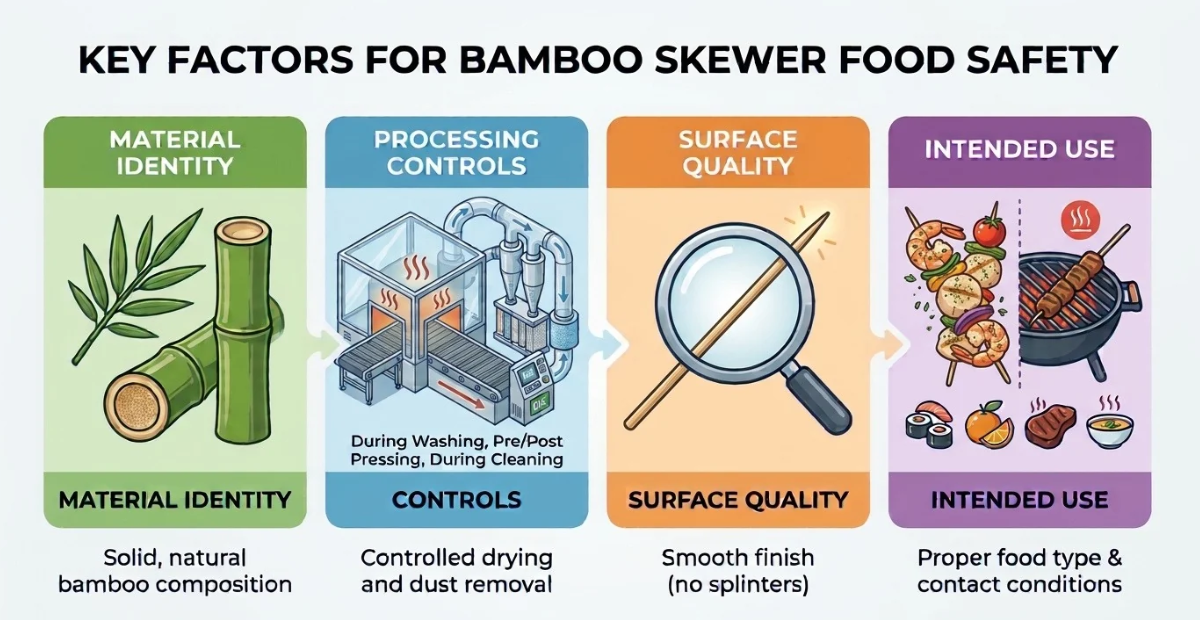
One scope note before we go further: this guide is about solid bamboo skewers. Coated bamboo chopsticks, bamboo-plastic cutlery and laminated bamboo boards raise different questions and are covered in our guide to disposable bamboo chopsticks and food safety standards. Mixing the two categories is one of the most common sourcing mistakes we see.
1.1 Raw Bamboo Material and Material Traceability
Start with the material, because everything downstream depends on it. Five questions worth asking before you approve a sample:
- Which bamboo species is used?
- Is the skewer solid bamboo, or a composite?
- Are any adhesives, coatings, resins or chemical treatments added at any stage?
- Where is the raw bamboo sourced?
- How are incoming materials inspected and stored before processing?
The species question is not pedantry. Different species behave differently in machining and drying, and a supplier who cannot name the species usually cannot tell you what changed between your first order and your third. If the answer is “bamboo” and nothing more, treat the material identity as unverified until you get a written declaration.
The composite question matters more, and it is where buyers get caught. A product described as “bamboo-based” may be plastic with bamboo powder as filler. Those two categories fall under different regulatory regimes, with different documentation requirements — Section 4 covers this in detail.
Traceability is the quiet one. Ask how raw material batches are recorded. If the answer is vague now, it will be vague in month eight when a distributor reports discoloration in one carton and you need to know which batch it came from. How raw bamboo is selected and supplied at QL Bamboo shows what this looks like in practice.
1.2 Manufacturing Hygiene and Processing Controls
Good raw material can still become a bad product. Bamboo is an agricultural material: it arrives with moisture, dust and microbial load, and every step from there either reduces that or adds to it. The stages that matter for skewers:
| Stage | What can go wrong | What to ask |
|---|---|---|
| Raw material preparation | Mud, mould, mixed species entering the line | How is incoming bamboo sorted and rejected? |
| Drying | Residual moisture leading to mould in transit or storage | What moisture range is targeted, and how is it measured? |
| Cutting and shaping | Inconsistent diameter, cracked shafts | What tolerance is held, and how is it checked? |
| Polishing | Loose fibres and burrs left on the surface | What finish is specified for food-contact use? |
| Dust removal | Bamboo dust trapped in packs | How is dust controlled after machining? |
| Packing and storage | Re-moisture, contamination, pest access | How are finished goods stored before shipment? |
You do not need to audit a factory to use this table. You need to notice whether the answers are specific. “Strict quality control” is not an answer to any row above. “We dry to 8–12% and check with a moisture meter per batch” is.
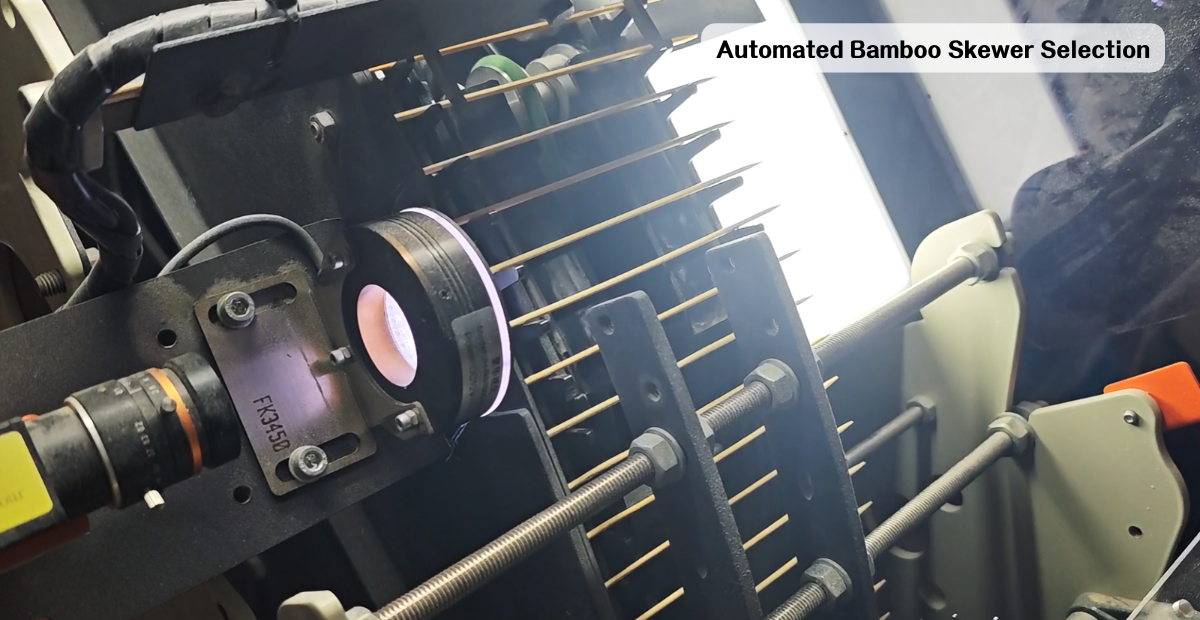
If a supplier walks you through the production process at this level of detail, that is itself a data point about how they run the plant. Our walkthrough of how bamboo skewers are made covers the sequence most plants follow, and storage and pest control is where many complaints actually originate.
1.3 Surface Quality and Physical Safety
Skewers touch food directly and are handled by people preparing it, so the physical condition of the product is a safety issue, not a cosmetic one. What to check on a physical sample — not a photograph:
| Inspection point | What good looks like | Why it matters |
|---|---|---|
| Surface smoothness | Evenly polished, no rough patches along the shaft | Rough surfaces trap residue and shed fibres |
| Splintering | No loose fibres, cracks or sharp fragments | A splinter in food is a customer complaint and a liability |
| Tip consistency | Uniform, appropriate to the application | Blunt vs pointed changes handling and presentation |
| Dimensions | Length and diameter within agreed tolerance | Affects portioning, packing density and machine feeding |
| Appearance | No mould, no unusual discoloration, no foreign matter | Discoloration is often the first visible sign of moisture problems |
| Strength | Survives the intended use without snapping | Grill heat, dense food and long shafts are all stress cases |

The strength row deserves a note, because “strong enough” means different things in different applications. A 250 mm skewer carrying dense meat over direct heat is a different engineering problem from a 90 mm pick holding a garnish. Specify the application, and the supplier can tell you which diameter and grade they would recommend — rather than you discovering it in the first service.
How to check straightness and surface quality before bulk ordering covers the physical inspection in more detail, including the checks you can do in ten minutes with a sample in your hand.
2. What Documents Should Importers Ask a Bamboo Skewer Supplier For?
Here is the part most buyers get wrong — not by asking for too little, but by asking for the wrong thing. A folder of certificates proves very little. A small set of documents that actually match your product proves a lot.
Different documents answer different questions. Some identify the product. Some support a compliance position. Some show that the factory controls its process. Some just tell you where the goods came from. Treating them as interchangeable is how buyers end up reassured by paperwork that does not apply to what they bought.
2.1 Bamboo Skewer Documentation Checklist
The table below maps each document to the question it actually answers, so you can ask for what you need instead of collecting everything.
| Document | The question it answers | Priority |
|---|---|---|
| Product specification sheet | What exactly am I buying? | Essential |
| Material declaration | What is it made of, including additives? | Essential |
| Food-contact compliance declaration | On what basis does the supplier claim suitability? | High — depends on market |
| Laboratory test report | What was tested, on which sample, by whom? | High — depends on risk |
| Batch traceability records | Can this shipment be traced to production? | High for repeat and private-label orders |
| In-process and finished-goods inspection records | How is quality actually controlled? | High for long-term supply |
| ISO 9001 certificate | Is there a certified quality system, and within what scope? | Useful context, not product proof |
| GMP procedures and records | How are manufacturing conditions managed? | Useful for EU-bound goods |
| FSC or chain-of-custody documentation | Is the sourcing claim supported? | Only if a sourcing claim is made |
| Phytosanitary certificate | Does this shipment meet plant-health rules? | Where the destination requires it |
| Certificate of origin | What origin is being declared? | Where customs requires it |
Two honest notes on this table. First, not every row applies to every order. The correct package depends on your product, your market and your risk tolerance — Section 7 turns this into a stage-by-stage version you can work from directly. Second, the more documents you request, the slower the quote. If you are buying samples or a single pallet for a trial, a specification sheet plus a material declaration is a reasonable minimum. The full package earns its cost when you are committing to repeat volumes, private label, or retail channels where your customer will ask you the same questions you are asking your supplier.
2.2 Product Specification Sheet
This is the document that prevents most disputes, and it is the one buyers most often skip because it feels administrative. It should pin down:
- Product name and internal product code
- Bamboo species and material composition, where available
- Length and diameter, with tolerances
- Shape and tip design (round, flat, pointed, blunt, knotted, looped)
- Surface finish
- Intended food-contact application
- Inner pack and outer carton specification
- Agreed quality acceptance criteria
The test is simple: could a new production manager read this sheet and make the same skewer six months from now? If the sheet says “bamboo skewers, 250mm” and nothing else, no.
Make sure it matches your approved sample, your quotation and your purchase order. For customized orders this is critical — a 5 mm difference in length or a change in tip geometry is a different product, and it is the kind of drift that shows up in a reorder rather than the first shipment. Our bamboo skewer specification range shows the parameters that normally need to be fixed in writing.
2.3 Material Declaration and Food-Contact Compliance Declaration
These two are constantly confused, and the confusion costs buyers real time. A material declaration describes composition. For skewers, it should state whether the product is solid bamboo and whether any coating, adhesive, resin or other material is present. If there is a coating, name it — “food-safe coating” is not a material.
A food-contact compliance declaration describes position: what the product is intended for, which requirements it has been assessed against, and any limitations on use. A usable declaration should identify the specific product covered, the composition, the intended contact conditions (temperature, duration, food type), the regulatory basis, any restrictions, and the technical evidence behind it.
What to watch for: a declaration that says “our products are food-grade” and nothing else. That sentence covers nothing, because it does not name a product, a market or a regulation. Ask for a declaration that names the SKU you are buying. If the supplier cannot produce one for that SKU, you have learned something useful before you paid a deposit.
Neither document substitutes for test evidence where test evidence is required. A declaration tells you what the supplier claims and why; a report shows what was measured.
2.4 Food Contact Test Reports
Test reports are the most over-trusted and under-read documents in food-contact sourcing. What gets tested depends on the material, the process, the intended use and the market. Depending on your case, relevant testing may cover chemical contaminants, migration (where technically and legally applicable), microbiological parameters where the risk assessment justifies it, and other product-specific evaluations.
Not every test applies to every solid bamboo skewer. A migration test designed for a plastic article does not automatically transfer to an untreated solid bamboo product — the material behaves differently, and the legal framework is different. Ask what a test is for before you accept it as reassurance. Seven things to check on any report you are handed:
- Laboratory — who ran it, and can you verify them independently?
- Accreditation — does the lab hold ISO/IEC 17025 accreditation for this specific test scope?
- Sample identification — is the sample named, and does it match your product?
- Material and specification — same species, same dimensions, same finish?
- Methods — which standard, and is it the right one for the claim being made?
- Results — units, limits, and an explicit conclusion?
- Date — recent enough to reflect current production?
The most common failure is item 4. A report is evidence about a sample, not about a factory. If the sample was a different skewer — different diameter, coated when yours is uncoated, made on a different line — the report does not support your product, and no amount of it being “on file” changes that. If the sample does not match, the right question is not “is this report valid?” but “can you test my specification?” That is a reasonable request, and a supplier who handles production volume will have an answer either way.
2.5 Manufacturing Hygiene and Quality Management Documents
Product testing tells you about a sample. Management documents tell you about the system that produced it. You want both, and you want to keep them separate in your head. Depending on what the factory actually runs, you may see ISO 9001 certification, GMP procedures, sanitation and cleaning records, incoming material inspection records, in-process inspection procedures, finished-goods inspection records, and non-conforming product handling procedures.
Two things to keep straight. ISO 9001 is a management-system certificate: it says an organization has a certified quality system within a stated scope, and it does not say your skewer meets any food-contact requirement. Useful, not sufficient. GMP records show how conditions are controlled — they are the most direct evidence that a factory thinks about hygiene as a process rather than an outcome, but they need to be read alongside the product specification, not instead of it.
The most useful version of this request is not “send me your certificates”. It is “walk me through what happens when a batch fails inspection.” The answer tells you more than the certificate does. QL Bamboo’s QC system is documented the same way, if you want a reference for what a written answer looks like.
2.6 Batch Traceability and Inspection Records
Traceability sounds like a compliance checkbox until the first quality claim, at which point it becomes the only thing that matters. Ask whether the supplier can connect a finished carton to:
- the raw material batch
- the production date and batch number
- in-process inspection records
- finished-goods inspection results
- release records
- the non-conformance process, if something was flagged
The practical test: if a distributor reports splintering in one carton six months from now, can this supplier tell you which batch it came from and what the inspection showed? If yes, you can investigate. If no, you can only negotiate — and you will be negotiating from a weak position, because neither side can establish what happened.
For repeat orders, batch records do something else useful. They let you tell whether a change in appearance or performance is a real production shift or normal variation. Without them, every complaint becomes an argument.
2.7 Additional Documents for Import and Distribution
Depending on origin, destination and your own commercial requirements, you may also need:
- FSC or chain-of-custody documentation — supports a certified-sourcing claim. Check the certificate holder, the scope, the validity dates and whether your supply chain is actually covered. FSC is a sourcing claim, not a food-contact safety certificate; the two get conflated constantly in marketing material.
- Phytosanitary certificate — addresses plant-health requirements for specific plant products and shipments. Whether you need one depends on the product’s processing status, the destination and its import rules. A finished, polished, packed skewer is treated differently from raw bamboo material. This is a shipment-level question for your customs broker, not a general one.
- Certificate of origin — declares origin where customs or trade rules require it.
- Commercial invoice and packing list — the documents your broker actually needs to clear the goods. Boring, and the most common cause of delay.
- Packaging specification — pack format, quantity per pack, carton details, labeling.
Confirm the exact list with your customs broker before shipment rather than after. Document problems discovered at the port are expensive in a way that document problems discovered at quotation are not.
3. Which Food Contact Regulations Should Bamboo Skewer Importers Consider?
Food-contact requirements are not global. The same skewer can be entirely routine in one market and require a specific assessment in another, and the difference is not about quality — it is about which legal framework applies. Identify your destination and your intended use first. Everything else follows from those two answers.
3.1 European Union: Regulation (EC) No 1935/2004
Regulation (EC) No 1935/2004 is the EU framework regulation for materials and articles intended to come into contact with food. Its core principle is that food-contact materials must not transfer constituents into food in quantities that could endanger health, cause an unacceptable change in food composition, or deteriorate taste and smell. It also establishes traceability obligations and the requirement for supporting documentation.
Two things worth understanding, because they are where expectations usually go wrong. There is no harmonized EU material-specific measure for bamboo. Unlike plastics, which have Regulation (EU) No 10/2011 with its positive list of authorized substances, bamboo has no equivalent EU-wide specific measure. In the absence of one, Member States may maintain or adopt national provisions under Article 6 of the framework regulation.
That means the answer to “is my bamboo skewer compliant in the EU?” depends on which Member State you are selling into. Practically: identify the country of first placing on the market, check whether that country has national provisions for wood and bamboo food-contact materials, and confirm with your buyer or a regulatory adviser. Do not accept “EU compliant” as a complete answer — ask which country, which provision.
For buyers working the EU market more broadly, our note on PPWR and bamboo cutlery covers the packaging-side rules that sit alongside food-contact law.
3.2 European Union: Regulation (EC) No 2023/2006
Regulation (EC) No 2023/2006 sets out Good Manufacturing Practice for food-contact materials and articles. It is about process, not product: the requirement is that manufacturing is controlled well enough that finished goods consistently meet the applicable rules. It covers suitable premises, staff awareness of critical stages, documented quality assurance, quality control systems, and appropriate selection of starting materials.
For you as a buyer, this is the regulation that justifies asking process questions rather than only product questions. When you ask how moisture is controlled, how dust is removed, how a non-conforming batch is handled — you are asking about exactly what this regulation addresses. If a supplier can describe those procedures concretely, that is a good signal. If the answer is a certificate and no description, you have learned that the certificate is doing all the work.
3.3 United States: FDA Food Contact Requirements
This is the section where most sourcing conversations go off the rails, so it is worth being precise. Under US law, a substance reasonably expected to become a component of food may be subject to food-additive requirements unless an exclusion or exemption applies. Depending on the substance and the use, the regulatory basis may be a provision in Title 21 of the Code of Federal Regulations, an effective Food Contact Substance Notification, a Threshold of Regulation exemption, or another applicable basis.
For wood and bamboo articles, the relevant provisions sit in 21 CFR Part 174–177 (indirect food additives: adhesives and components of coatings, paper and paperboard components, polymers, and adjuvants). If your skewer has a coating or an adhesive anywhere in its construction, those parts are where the question actually lives — which is why the material declaration in Section 2.3 matters more than it looks.
The FDA does not issue an approval certificate for bamboo skewers. There is no such document. Any supplier offering “FDA approval” for a skewer is either misusing the term or referring to a facility registration that has nothing to do with product compliance. Two distinctions that resolve most confusion:
- Facility registration is not product compliance. A food facility registration is an administrative registration. It says nothing about whether a specific article is suitable for food contact.
- The FDA Food Code is not an import approval. The Food Code is guidance for retail and foodservice operations, including provisions on wood used in certain food-contact applications. It is not a product-specific clearance for disposable bamboo skewers.
So what should you ask instead of “do you have FDA approval?” Ask which regulatory basis the supplier is relying on for the material, and for any coating or adhesive used. A supplier who can answer that is working from the regulation. A supplier who cannot is working from a logo.
3.4 Other Destination Markets: UK, Canada, Australia and Beyond
Do not assume EU or US documentation satisfies a third market. It often does not, and the gaps are rarely where buyers expect them. Before ordering, confirm:
- which food-contact rules apply to this product in this country
- whether additional national testing or documentation is required
- whether plant-product import controls apply (this varies widely by processing status)
- whether packaging and labeling requirements differ
- whether your customer — retailer or distributor — has its own compliance standard on top of the legal one
The efficient move is to tell the supplier the destination country and intended application at the quotation stage. Documentation requirements discussed before production are a planning item. The same requirements discovered after production are a delay.
4. Solid Bamboo Skewers Are Not the Same as Bamboo-Plastic Products
This section matters most for anyone selling into Europe, and it is the single most consequential distinction in this guide. Solid bamboo skewers and bamboo-plastic composite products are different materials, governed by different rules, and frequently marketed with the same words.
In recent years the European Commission has taken enforcement action against plastic food-contact products containing unauthorized bamboo powder and other plant-based additives. These products are typically sold as “bamboo tableware” even though their structure is plastic, with bamboo powder or fibre added as filler. Under Regulation (EU) No 10/2011, plastic food-contact materials must meet specific compositional requirements — including which substances are authorized for use. Bamboo powder and certain other plant-based additives are not automatically authorized.
4.1 What Was the EU “Bamboo-zling” Enforcement Action?
The European Commission coordinated an enforcement action known as “Bamboo-zling” targeting the illegal import, trade and advertising of plastic food-contact products containing unauthorized bamboo powder and other plant-based additives. The action involved 21 participating countries and reported 748 cases:
- 644 cases involved products identified on the EU market
- 104 cases involved goods rejected at the EU border
Note precisely what the action concerned: plastic food-contact materials containing unauthorized plant-based additives. It was not a ban on products made entirely from natural bamboo. The Commission draws that distinction explicitly, and it matters — buyers have walked away from perfectly compliant solid bamboo suppliers because they misread a headline.
4.2 What Does This Mean for Bamboo Skewer Buyers?
The practical difference between the two material categories:
| Comparison point | Solid bamboo skewers | Bamboo-plastic composite products |
|---|---|---|
| Main composition | Solid bamboo material | Plastic polymer with bamboo powder or fibre |
| Structure | Natural bamboo structure | Plastic matrix, bamboo as filler |
| Regulatory basis | Framework rules for the actual material, plus national provisions in the destination country | Plastics regulation (EU) 10/2011 and its authorization requirements |
| What you verify | Solid bamboo composition and processing | Polymer identity and authorization of every additive |
| Typical documentation | Material declaration, food-contact declaration, test reports on the bamboo article | Plastic-specific declaration of compliance and migration testing |
Solid bamboo is not a plastic article. EFSA’s guidance on non-plastic food contact materials explains how such materials are assessed outside the EU plastics framework — useful background when a buyer or a customs officer asks you to prove which category your product falls into. Five steps for skewer buyers:
- Confirm the product is made from solid bamboo.
- Ask directly whether any plastic, resin or composite material is present.
- Request a written material declaration that states this.
- Check that the product description your supplier uses matches reality — including on marketplaces.
- Verify the applicable food-contact requirements for your specific market.
Two failures to avoid, in opposite directions. Do not assume that enforcement against bamboo-plastic tableware applies to your solid bamboo skewers. And do not assume a product is compliant because it is described as natural or plastic-free — the description is a claim, and claims need the same verification as everything else in this guide.
5. What a Missing Answer Actually Tells You
Before the verification steps, one idea that will save you time. Most buyers treat an incomplete document package as an inconvenience and keep pushing. It is more useful to treat each missing answer as information — because the pattern of what a supplier cannot answer tells you more about the factory than the documents they can hand over.
The table below turns common evasions into a decision rule. None of these points prove a product is unsafe. They tell you whether the supplier can support the claim at all, which is the question you are actually answering before a bulk order.
| If the supplier… | Treat the claim as… | Do this |
|---|---|---|
| cannot name the bamboo species | unverified material identity | request species and origin before sampling |
| says “bamboo” without stating solid or composite | an ambiguous material category | require a written material declaration |
| shows a certificate but not its scope page | an unverified scope | ask for issuing body, certificate number and scope |
| shows a lab report whose sample ID differs from your SKU | non-transferable evidence | ask whether the report covers your specification |
| offers a report with no sample photo or no method section | unattributable | request a report traceable to a physical sample |
| states “FDA approved” | a framing error | ask which 21 CFR part or notification applies |
| describes moisture control without a number | an unquantified control | ask for the declared range and the test method |
| cannot produce batch records for a past shipment | no traceability | require batch coding in the PO before the next order |
Read it as a diagnostic, not a scorecard. A supplier who fails one row and explains why is in a better position than one who fails none because they never get asked.
6. How to Verify a Bamboo Skewer Supplier Before Bulk Ordering
Documents are one input. Samples and process questions are the others, and they catch different failures. This sequence is designed so that each step can stop the process cheaply if it needs to.
Confirm the Material
Get the material declaration first, before samples, because everything else is built on it. Confirm the species where available, whether the skewer is solid bamboo, whether any coating, adhesive or other material is used, and whether any chemical treatment has been applied. If the answer is “natural material”, ask again more specifically. A manufacturer that works with bamboo daily can describe what it buys. One that cannot is likely reselling.
Match the Documents to the Product
Never review a certificate or a report in isolation. Lay it next to the specification and the sample. Check that product names and codes match, material descriptions are consistent, dimensions are identifiable, test methods are appropriate to the claim, the laboratory can be independently verified, the stated requirements match your destination market, and any limitations on use are stated rather than implied. The uncomfortable question worth asking out loud: “Does this report cover the product I am ordering, or a different one?” Suppliers generally answer honestly. What they cannot do is answer a question you did not ask.
Inspect a Representative Sample
A sample catches what documents cannot. Test it under conditions close to real use: a skewer for grilled meat goes on heat with weight on it, a pick for a garnish does not. Testing both the same way tells you nothing about either.
| Check | What you are looking for |
|---|---|
| Surface | Smooth, evenly polished, no rough patches |
| Splinters | No loose fibres, no obvious splinters along the shaft |
| Tips | Consistent, appropriate to the application |
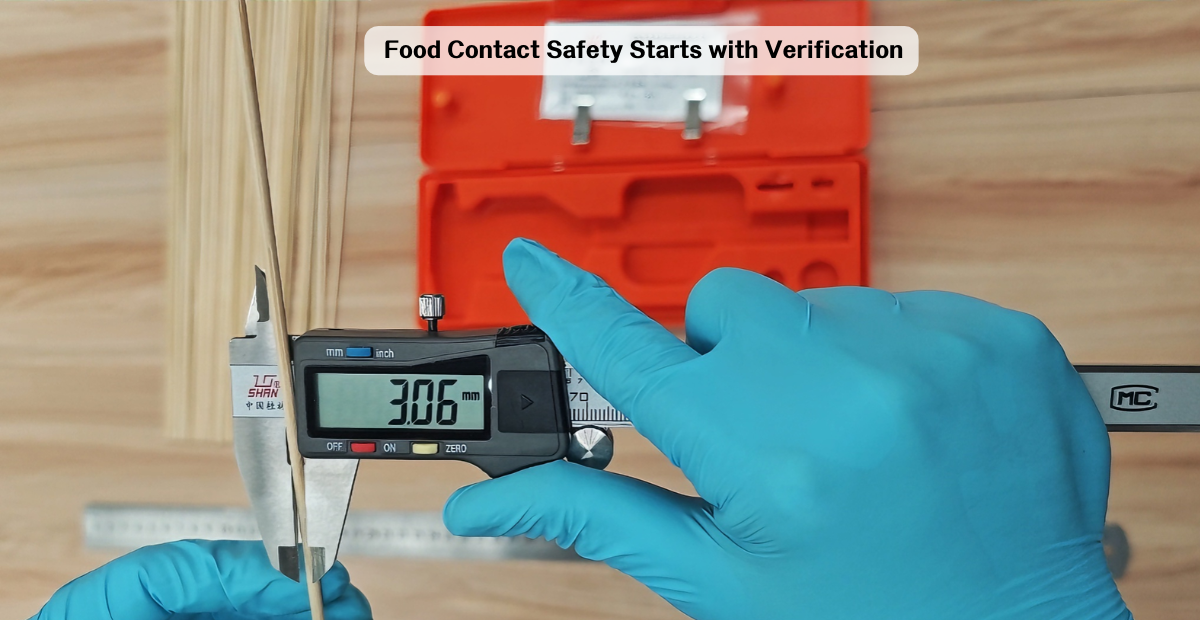
| Dimensions | Within the agreed tolerance, measured — not eyeballed |
| Appearance | No mould, no unusual discoloration, no foreign matter |
| Strength | Survives the intended use — snap test under load if relevant |
| Packaging | Clean, intact, appropriate for storage and transit |
Approve a physical sample in writing before mass production, particularly with custom dimensions, printing or private-label packaging. “Same as last time” is not a specification, especially when last time was two years ago.
Ask Process Questions
This is where you separate a trading company with good photography from a manufacturer with a system.
Useful questions, all of which have concrete answers if the factory is real:
- How are incoming bamboo materials inspected, and what gets rejected?
- How is moisture managed during drying and storage, and what range is targeted?
- How are cutting and polishing defects identified?
- How is residual dust removed before packing?
- How are finished products inspected, and against what criteria?
- How are production batches identified?
- What happens when a batch fails?
- How are finished goods protected between production and shipment?
You are not looking for perfect answers. You are looking for specific ones. A factory that says “we check every batch with a moisture meter and record it” is answering; a factory that says “we have strict QC” is not, and the difference will show up in your third shipment rather than your first. If you want to run a fuller evaluation — including the commercial and continuity questions that matter for multi-year supply — our guide to evaluating a bamboo skewer supplier for long-term supply goes deeper than this section.
Put the Requirements in Writing
Before production starts, move what you agreed into the purchase order or the product specification. Verbal approvals are the single largest source of reorder disputes. Include material and dimensions, tip design and surface requirements, quality acceptance criteria, packaging format and quantities, carton specification and labeling, required supporting documents, schedule, and batch identification requirements. This document serves you twice: once now, to prevent misunderstanding, and once at reorder, as the reference that answers “is this the same product?” without a meeting.
7. Documentation Checklist by Order Stage
The table in Section 2.1 tells you what each document is for. This one tells you when to ask for it, because requesting everything at once is both slow and, in the early stages, pointless.
| Stage | What to request | What you are deciding with it |
|---|---|---|
| Quotation | Specification sheet draft, material declaration, confirmation of solid vs composite, destination market | Whether this supplier can serve your product at all |
| Sampling | Physical sample, specification matching the sample, any existing report with sample identification | Whether the product matches your application |
| Pre-production | Approved specification, food-contact declaration, test reports matched to your SKU, packaging artwork proof | Whether to release the order |
| Pre-shipment | Finished-goods inspection records, batch identification, packing list, photos of actual cartons | Whether to release the balance payment |
| Customs clearance | Commercial invoice, packing list, certificate of origin, phytosanitary certificate if applicable, any destination-specific declaration | Whether the goods can enter |
Two notes on using this. First, the pre-production row is where most of the value sits — that is the last point where a documentation gap can still be fixed by a phone call rather than a delay. Second, do not treat the rows as gates you must pass in full. A trial order can reasonably skip rows that only matter at volume.
When the full package is not worth the effort: if you are buying samples, or a single pallet for an event, or testing a market, the specification sheet plus a material declaration is a proportionate minimum. Batch traceability and a full compliance dossier earn their cost when you are committing to repeat volume, private label, or retail channels where your customer will ask you the same questions. Spending three weeks on documentation for a 20-carton trial is not diligence — it is a different way of losing the order.
8. What Should Buyers Expect from a Bamboo Skewer Manufacturer?
A manufacturer worth a long-term relationship should be able to talk about three things without preparation: what it makes, how it controls quality, and what it can document.
8.1 Clear Product Specifications
The manufacturer should be able to discuss length and diameter ranges, round versus flat profile, tip design, surface finish, strength requirements for the intended application, and inner-pack and carton specifications — with numbers, not adjectives. For customized projects, ask whether they can work from a drawing, a reference sample or a written specification. The answer tells you whether customization is a routine capability or a special favour.
8.2 Documented Quality Control
Ask how quality is managed at each stage: incoming material, cutting and shaping, polishing, dust removal, finished-goods inspection, packing. The useful question is not whether the factory inspects. It is whether the inspection criteria are defined, recorded, and tied to the product you are buying. A factory that inspects against a written standard and a factory that inspects by feel can both say “we inspect”.
8.3 Relevant Supporting Documents
Ask which documents actually exist for your specific product — not for the company in general. Depending on product and market: specification sheets, material declarations, laboratory reports, quality-system certificates, production inspection records, batch traceability information, sourcing and shipment documents. A good supplier will tell you what each document covers and, just as importantly, what it does not. Be cautious with any supplier who presents unrelated certificates as universal proof; it usually means they have not been asked the specific question before.
8.4 OEM and Private-Label Coordination
For distributors and brands, quality is half the project. Packaging is the other half, and it fails on its own schedule. Confirm individual pack format, quantity per pack, quantity per carton, labeling and barcode requirements, logo or private-label printing, carton markings, artwork approval steps and packaging lead time.
The reason to settle this early is simple arithmetic: packaging has its own production lead time, and it starts after artwork approval. A specification approved in week two and artwork approved in week six puts you four weeks behind a schedule you thought you had. How packaging is coordinated at QL Bamboo shows the sequence most projects follow.
9. Frequently Asked Questions About Bamboo Skewer Food Safety
Are bamboo skewers FDA approved?
There is no FDA approval certificate issued for bamboo skewers as a product category. US food-contact compliance depends on the material, the intended use and the applicable regulatory provisions — for wood and bamboo articles, generally 21 CFR Part 174–177, plus the specific requirements that apply to any coating or adhesive used. Be sceptical of “FDA approved” as a phrase: it usually refers to a facility registration, which is administrative and says nothing about product suitability.
Do bamboo skewers need food-contact testing?
Not every bamboo skewer is subject to the same mandatory testing. What applies depends on the material, the manufacturing process, the intended contact conditions, and the destination market’s rules. What you should expect is that a supplier can tell you what has been tested and why — and can arrange testing on your specification if the existing reports cover a different product. If neither is possible, treat the food-contact claim as unsubstantiated.
What certificates are required to import bamboo skewers into the EU?
There is no single EU certificate that covers every solid bamboo skewer. The relevant framework is Regulation (EC) No 1935/2004, with GMP requirements in Regulation (EC) No 2023/2006, plus whatever national provisions apply in the Member State where the product is first placed on the market. Identify the country, check its national provisions for wood and bamboo food-contact materials, and ask your supplier for documentation that references that basis rather than a generic “EU compliant” statement.
Are 100% bamboo skewers safer than bamboo-plastic composite products?
They are different material categories assessed under different rules, so “safer” is the wrong comparison. The EU enforcement action targeted plastic food-contact products containing unauthorized bamboo additives — not products made entirely from bamboo. That said, being 100% bamboo does not remove the need for material, process and quality controls. A solid bamboo skewer made with poor drying and dusty packing is still a problem; it is just a different problem.
What is the difference between a food-contact declaration and a laboratory test report?
A declaration is a written statement of intended use and the regulatory basis on which suitability is claimed. A test report records what was measured, on which sample, by which method. A declaration without supporting evidence is a claim. A report without a matching sample is unrelated evidence. You want the pair, and you want them to refer to the same product.
Can an ISO 9001 certificate prove bamboo skewers are food safe?
No. ISO 9001 certifies a quality management system within a stated scope. It does not establish that a specific product meets any food-contact requirement. It is still useful — a certified system makes consistent production more likely — but it answers a different question than the one you are asking. Pair it with product-specific documentation.
Is FSC certification required for importing bamboo skewers?
FSC is not a universal food-contact or import requirement. It supports a certified-sourcing claim when the certificate scope and supply chain actually cover your product, and it is worth having if you make sustainability claims in your marketing. It is not a food-safety document, and it should not be presented as one. If a supplier’s only document is an FSC certificate, you have not yet seen any food-contact evidence.
What HS code are bamboo skewers classified under?
Bamboo skewers are generally classified under HS heading 4421 (other articles of wood), with the specific subheading depending on the destination tariff schedule and, in some markets, on whether the article is of bamboo specifically. Classification is ultimately determined by the importing country’s customs authority, so confirm the code with your broker before shipment — and make sure the commercial invoice, packing list and certificate of origin all state the same code.
What MOQ and lead time should I expect for bulk bamboo skewers?
Both depend on three variables: the specification (length, diameter, tip design), the packaging format (bulk carton versus individual retail packs), and whether the order repeats an already-approved specification. Standard sizes in bulk cartons generally move faster than a new private-label run, which needs artwork approval and packaging production before filling can start. Ask for MOQ and lead time quoted against a written specification rather than a product category — the category-level number is almost always optimistic.
Can bamboo skewers be private-labeled or custom-packed?
Yes. The practical constraints are packaging format, artwork approval, and label compliance in the destination market. Settle pack quantity, barcode requirements, carton markings, and who owns the artwork before production. Ask for a physical or digital packaging proof before the run — correcting a label after printing is one of the more expensive mistakes in this category, and one of the easiest to avoid.
What broken or splintered rate should a buyer accept?
This should not be left as “as low as possible” — that is not a criterion anyone can inspect against. Agree a sampling plan and a defect classification in the purchase order, for example an AQL scheme with critical, major and minor categories, and define which defects (splinters, mould, dimensional deviation) fall into each class. Without a written acceptance criterion, there is no objective basis for a claim.
Does a bamboo skewer shipment need a phytosanitary certificate?
It depends on the product’s processing status, the destination country and its plant-health import rules. A finished, polished and packed skewer is treated differently from unprocessed bamboo material, and requirements vary considerably between markets. This is a shipment-level question, so confirm it with your customs broker and the destination authority for your specific origin–destination pair.
What if the supplier will not share documents at all?
That is itself an answer, and you can act on it. Some suppliers genuinely cannot produce documents because they buy finished goods from another factory. Others can, but treat documentation requests as a sign of a difficult customer. Both cases tell you what a long-term relationship would look like. A reasonable middle path for a first order: ask only for the specification sheet and the material declaration, get a sample, and place a trial order small enough that the documentation risk is tolerable. What you should not do is place a large first order on the assumption that documentation will appear later — it rarely does.
What information should I send when requesting a quotation?
The more specific your brief, the more useful the quote. Suppliers can price a category from memory, and that number will be wrong. Send: required length and diameter, shape and tip design, intended food application, estimated order quantity, individual and bulk packaging requirements, destination market, required compliance documents, and any OEM or private-label requirements. This is also the fastest way to find out whether a supplier understands your market.
Conclusion: Food Safety Is a Document Trail, Not a Material Claim
Are bamboo skewers food safe? Yes, they can be — and the fact that they are made from bamboo is the least informative part of the answer. What actually determines suitability is whether the material is what it claims to be, whether the process is controlled, whether the documentation refers to your product rather than a similar one, and whether a finished carton can be traced back to a production record.
- Material identity — solid bamboo, or a composite? Get it in writing.
- Process control — how moisture, dust, defects and packing are managed.
- Food-contact documentation — a declaration that names your SKU, supported by reports on a matching sample.
- Physical quality — a sample you have held and tested, not a photo.
- Traceability — batch records that can answer a complaint six months later.
None of this requires a laboratory or a compliance department. It requires asking specific questions and noticing which ones get specific answers. Most of the risk in this category is not hidden — it is simply unasked.
You do not need to buy anything to use this guide. The checklist in Section 2.1 and the stage table in Section 7 work with any supplier, including the one you are already talking to. If you are evaluating bamboo skewers for a specific market, the fastest way to a useful conversation with us is not a catalogue request: send the specification you need — length, diameter, tip, application, packaging, destination — and ask which of the documents in this guide we can provide for that specific SKU, and which we cannot.
QL Bamboo supplies solid bamboo skewers and bamboo foodservice products for wholesale, OEM and private-label programmes. Tell us your specification and we will tell you what documentation we can support for it — before you commit to a volume.